The Tyszkiewicz Family: What a Manor's Generations Teach Us About Our Own
For 89 years Lentvaris Manor belonged to a single family. From 1850 to 1939 its owners were three generations of the Tyszkiewicz family: Count Józef, his son Władysław, and finally Władysław's widow and children. Each generation left its mark on the building, the park and the life of the estate. But the most interesting part of the story is not only the architecture. Looking at several generations in a row, you can see how some things in a family repeat, others change, and others are cut short by events nobody could have chosen. It is a question worth asking about our own families too.
The first generation: Józef and Zofia
In 1850 Count Józef Tyszkiewicz (1835–1891) bought the estate from the Szachno family; some sources give the year as 1855. Lentvaris was not his only property: Józef also owned the estate at Kretinga in western Lithuania and added further land over the following decades.
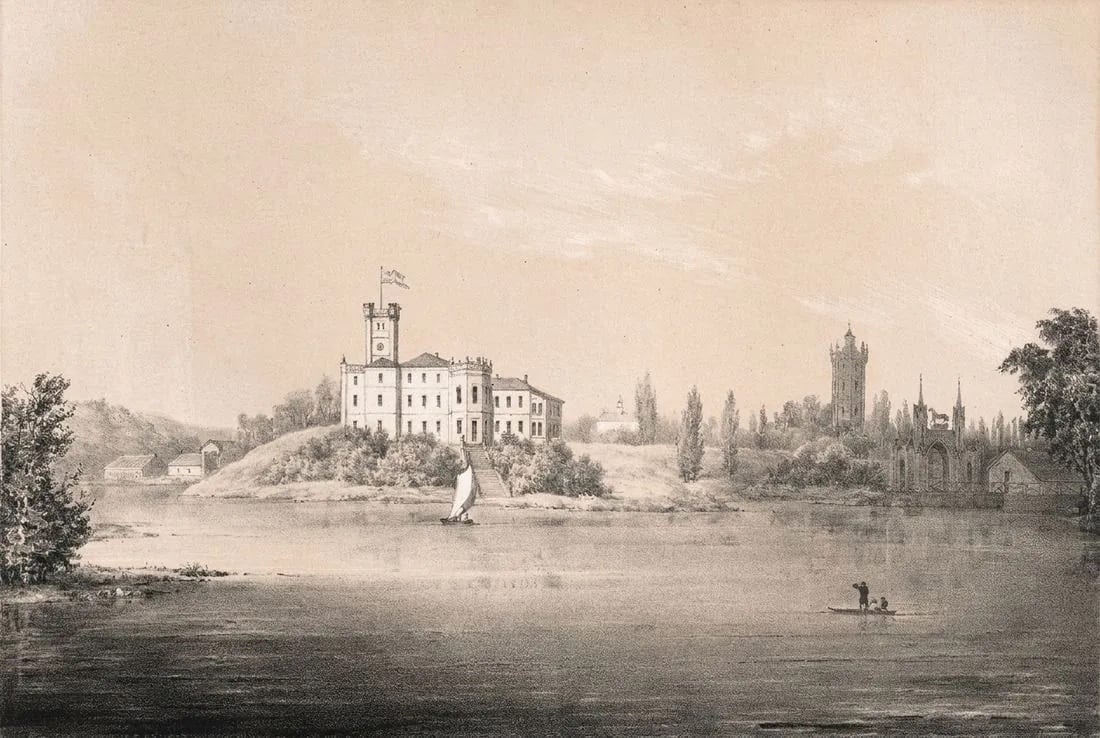
Józef married Zofia Horvat, the daughter of a Polish noble family. Their children included two sons, Władysław and Aleksander, and a daughter who, like her mother, was named Zofia. In 1865–1866 the first Tyszkiewicz palace rose by the lake, designed by the German architect Friedrich Gustav von Schacht. It was not yet Gothic Revival: a pale building with a tall tower and a façade turned towards the water. A lithograph from the period shows Gothic gates on the right, crowned with the statue of a horse. Remember that detail, because horses come back again and again in this family.
The second generation: Władysław and Maria Krystyna
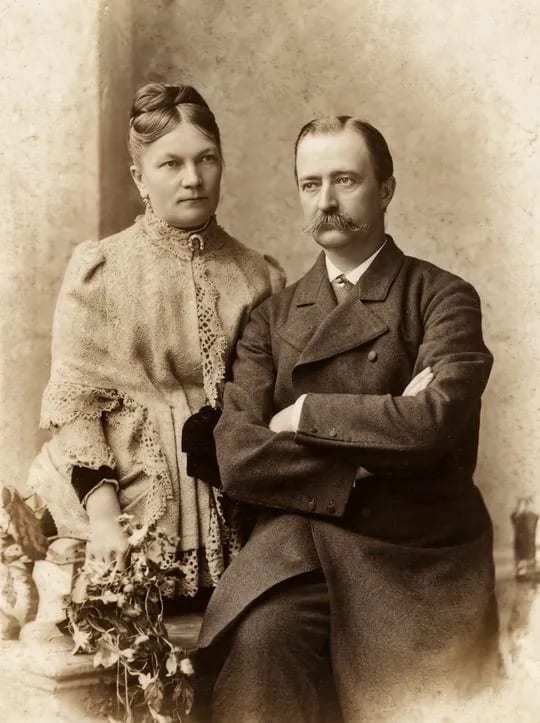
Józef's son Władysław Tyszkiewicz (1865–1936) graduated from the law lyceum in St Petersburg in 1886 and served as a justice of the peace in Riga. As heir he received the Lentvaris estates, and at the end of the nineteenth century he moved to Warsaw. There he sat on the committees that built the Adam Mickiewicz monument and the Warsaw Philharmonic, and from 1903 he headed the Warsaw Society for the Promotion of Industry and Trade. In 1906 he was elected to the first Russian State Duma. For his national activity the tsarist authorities twice exiled him to the Arkhangelsk governorate. Later, in Milan, he opened an antiques shop and called it "Warowland", a play on the name of his family home, Landwarów.
Władysław married Princess Maria Krystyna Lubomirska. Her brothers gave the couple a stallion and four mares brought from England as a wedding present, and in 1893 the countess founded a stud farm at Lentvaris that had grown to a hundred horses by 1900. In November 1903 she personally led a group of riders all the way from Lentvaris to Warsaw on horseback. Władysław, for his part, was elected vice-president of the Vilnius horse races. You can read more about her in our article on Maria Christine Tyszkiewicz.
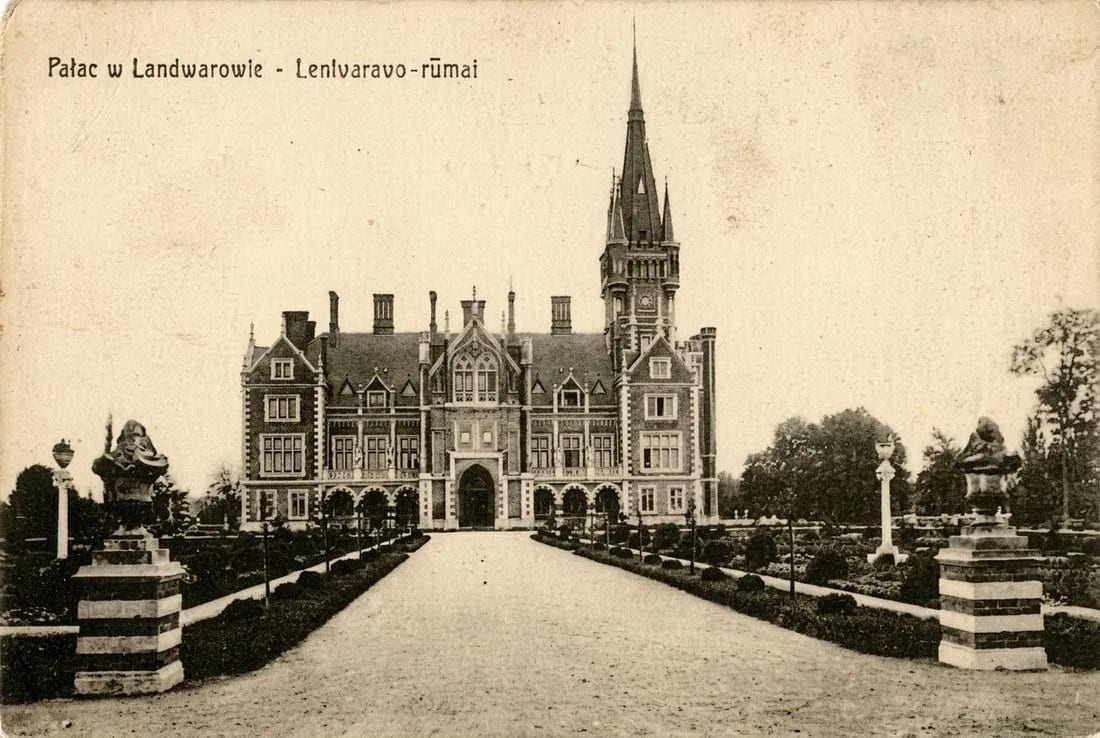
In 1890 Władysław decided to rebuild the palace from the ground up. The work, supervised by the Belgian architect de Waegh together with Tadeusz Rostworowski, lasted until 1899. The result is the red-brick Gothic Revival palace with its six-storey tower that stands today, surrounded by the park designed by Édouard François André. The family spent its winters in Warsaw.
The third generation: children scattered by war
Władysław and Maria Krystyna raised four children: Zofia Róża, Stefan, Róża and Eugeniusz Stanisław. The eldest daughter was once again called Zofia, the third Zofia in a row in this family. As Zofia Tyszkiewicz-Potocka she later wrote extensive family memoirs, and much of what we know today about daily life at Lentvaris comes from them. Her story is told in our article on the Countess of Lentvaris.
This generation lived through turbulent times. During the First World War the palace was ransacked and a large art collection was taken to Russia, where it disappeared. In 1925 the Polish land reform forced the family to sell part of its estates. Władysław died at Lentvaris in 1936 and was buried in the local church. In 1939 the Tyszkiewicz era at Lentvaris came to an end. During the Second World War some family members were persecuted, others died in camps, and the survivors emigrated. Władysław's son Stefan, an engineer and inventor, died in London in 1976.
Patterns passed down the generations
Look at these three generations side by side and a few recurring themes appear. The first is horses. A horse statue crowned the gates in Józef's day; Władysław was vice-president of the horse races; Maria Krystyna founded a stud farm and rode to Warsaw. What was a passion for one generation became work and part of the identity of the next.
The second theme is building and rebuilding. The father built a palace; the son rebuilt it from the ground up. Each generation wanted to make the house its own, yet each built on the same foundations, by the same lake. Even far from home, in Milan, Władysław named his business after the family estate.
The third theme is names and memory. Zofia was Józef's wife, Zofia his daughter, and Zofia his granddaughter, who decades later wrote down the history of the whole family. What a family passes on is not always objects or land. Sometimes it is names, stories and a sense of duty to remember.
Similar repetitions can be found in almost every family, though they are rarely as visible as in the story of a manor. Along with a house or a name, families also hand down invisible things: how money is talked about, how conflict is handled, whether weakness may be shown, what counts as success. We often repeat them without noticing. Some are worth keeping, like the Tyszkiewiczs' respect for the history of their home. Others, such as silence about pain or tension absorbed from parents, are worth stopping on purpose.
Ema Sakalauskaitė writes in depth about how to recognise the patterns that repeat across generations in your own family, what science says about them, and what it means to be the one who breaks the cycle:
How to look at your own family's story
We can follow the Tyszkiewicz story today because it was written down: in archive documents, photographs, postcards and Zofia Tyszkiewicz-Potocka's memoirs. Most families' histories survive only by word of mouth, and each generation loses a little more of them. So it is worth starting with simple steps.
- Sketch three generations. Write down your grandparents, your parents and yourself, and next to each name where they lived, what they did, how many children they had and which names repeat.
- Ask your oldest relatives. Not only for dates, but for how the family talked about money, work, illness, divorce and war. Often what matters most is what was never discussed.
- Mark the repetitions. Professions, moves, early losses, marriages that followed a similar course. Sometimes a pattern only becomes visible once it is written on paper.
- Keep what you have. Scan old photographs and note who is in them while there is still someone who remembers.
What the palace remembers today
After the Tyszkiewiczs, the palace had other owners and other uses. In Soviet times it housed a carpet factory and later the factory's offices, and from 1992 it stood empty for many years. A new chapter began in 2016, and the palace is gradually being restored. Even so, traces of earlier generations remain: the family coats of arms on the façade, the park paths, the lakeshore that all three generations of Tyszkiewiczs looked out on.
The manor's story is a reminder that a family is not only what we receive. It is also what we decide to do with that inheritance. The Tyszkiewiczs preserved, built and wrote things down. We can do something similar: recognise what we have inherited, keep what is valuable, and have the courage to change what holds us back.
If you would like to see these places for yourself, join a guided tour of Lentvaris Manor. In about an hour and a half you will visit the palace halls, the tower and the park and hear more about the Tyszkiewicz family. Tours in English can be arranged.
Sources and Recommended Literature
- Wikipedia. Lentvaris Manor
https://en.wikipedia.org/wiki/Lentvaris_Manor - Wikipedia (PL). Pałac Tyszkiewiczów w Landwarowie
https://pl.wikipedia.org/wiki/Pa%C5%82ac_Tyszkiewicz%C3%B3w_w_Landwarowie - Wikipedia (PL). Władysław Tyszkiewicz (1865–1936)
https://pl.wikipedia.org/wiki/W%C5%82adys%C5%82aw_Tyszkiewicz - Wikipedia (PL). Stefan Tyszkiewicz
https://pl.wikipedia.org/wiki/Stefan_Tyszkiewicz