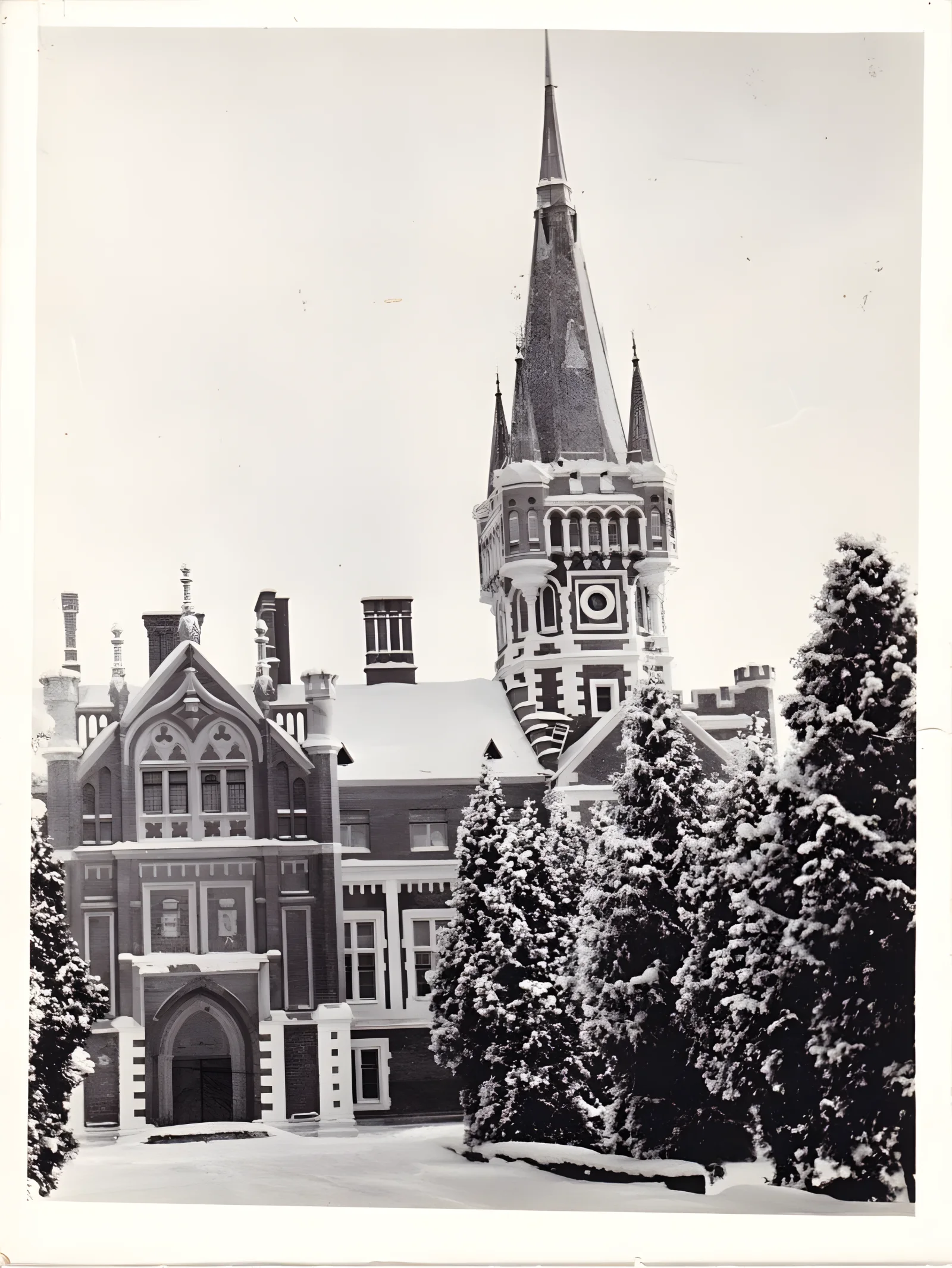
Lentvaris Manor During the Soviet Era
The Soviet era in the history of Lentvaris Manor was a period of paradoxes. It was neither a complete destruction nor a true revival. At one point, the palace was ravaged and depleted; at another, it unexpectedly became the birthplace of one of Lithuania's most prominent industrial facilities. This period reveals how an ideologically alien system sometimes inadvertently preserved what it would have otherwise destroyed.
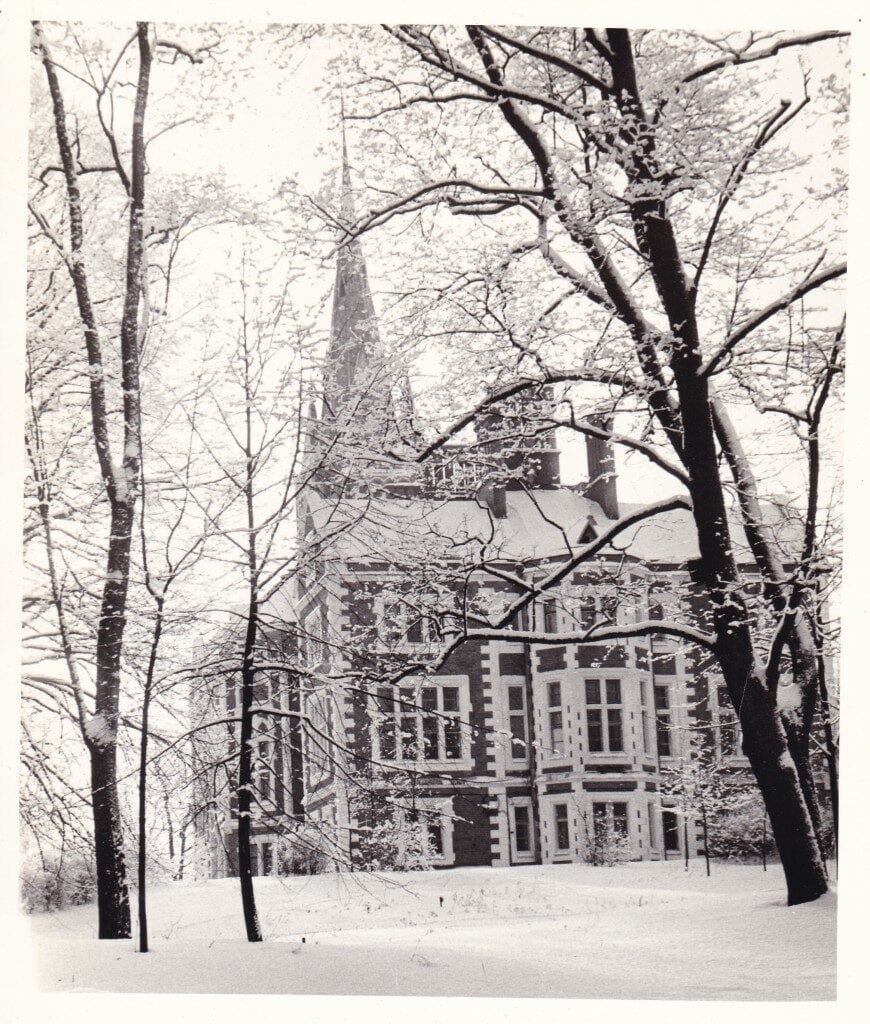
The Lentvaris Manor palace building. Photo by Ala Michenkova. Photo from the Voruta archive, received on March 18, 1987, No. 529
Wars barely touched Lentvaris Manor—the palace and the park entered the Soviet era still maintaining a respectable appearance. However, changes soon began that fundamentally altered the environment. The stone bridges in the park were blown up, and their stones were used for other structures. Until 1957, the palace itself stood empty, abandoned, and without a clear purpose.
The turning point occurred when the Deputy Minister of Light Industry, I. Teriosin, arrived in Lentvaris. His decision was typical of Soviet logic: a representative building must "work." Thus, it was decided to establish a manufacturing facility in the manor's palace. Old, obsolete looms were brought in from the Kaunas woolen fabric factory Drobe, and carpet production began. By 1958, after funds were allocated to adapt the premises, nearly 300 people were working in the palace.
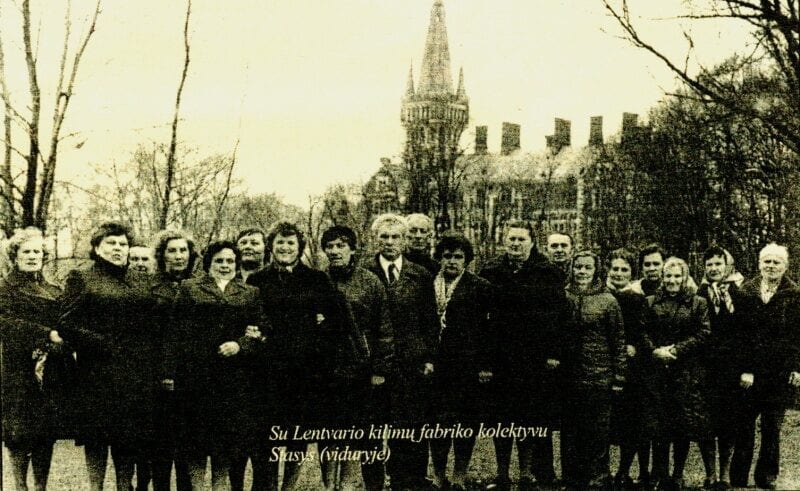
Former deportee Stanislovas Kasperavicius with the Lentvaris carpet factory team by the palace. Photo from the Lentvaris Library collections
However, the beginning was difficult. There was a lack not only of proper equipment but also of security, stability, and even basic peace. This was especially felt by the factory's artists—the people who created the carpet designs and ornaments. Artist Genovaite Zilinskaite recalled that in the early years, the manor and the park caused anxiety: vagrants and treasure hunters, who believed in the hidden wealth of the counts, would prowl around at night. The artist lived in the factory premises for almost two years until she received an apartment on Linden Avenue, and the constant tension and fear severely affected her health.
Only later did the manor's surroundings begin to be tidied up. Factory engineer Kazys Atkociunas took on the revitalization of the park, and later, director Liucija Talackiene initiated restoration work on the palace and the tower, and commissioned an inventory of the park's greenery. These were isolated but important attempts to restore at least some of the lost dignity.
Nevertheless, it was not the walls or the park that kept the manor alive, but the people. The Lentvaris carpet factory became not only a place of production but also a social refuge. Over a five-year period, about 1,400 technical improvements were developed and implemented here, saving more than 500,000 rubles. But more importantly, the factory provided work for those who needed it most.
People returning to Lithuania after deportation found an opportunity to start anew in Lentvaris. Vaclovas Ruksenas, who arrived in 1958, first found employment at the Kaitra factory and later moved to the carpet factory. He was helped by people who had themselves experienced repression—chief mechanic E. Strazdas and weaving shop manager A. Kairiunas, a former political prisoner. Another deportee, Stanislovas Kasperavicius, moved to Lentvaris after learning that his friend from exile, Ceslovas, worked there. Thus, a kind of guardianship reappeared in the palace—no longer that of the counts, but of people for other people.
At the same time, the manor's outbuildings suffered a completely different fate. A Soviet state farm was established in them, and the park began to be used for utilitarian purposes. Residents cut down trees for firewood, built sheds and barns, and polluted the area with household waste. Schoolchildren were sent for cleanup work, and during these working bees, they not only collected trash but also cut down "worthless" trees—often not realizing that they were destroying rare greenery carefully selected back in the 19th century. Over time, the barn burned down, and other outbuildings were severely vandalized.
Thus, Lentvaris Manor lived a double life during the Soviet era. The palace, having become a factory, was saved from complete ruin. The outbuildings and the park, on the contrary, suffered irreversible losses. This was a period when the manor transformed from a representative space into a functional facility, but it was precisely this transformation that allowed it to survive until the days when it became possible to speak of restoration once again.
- Giedre PETREIKIENE, Vilnius. Maple Avenue
- Jasiukeviciene, Egle. Histories of Lentvaris Deportees. Aukstaitija – Siberia – Lentvaris – Carpets. Vilnija Chronicle, October 31, 2003.
- Jasiukeviciene, Egle. Histories of Lentvaris Deportees. Carpet Maker – Deportee – Veteran. Vilnija Chronicle, October 17–23, 2003.
- Klusas, Rimantas. A Masterpiece Surrounded by Trees and a Lake. Our Homestead, December 2000, p. 1.
- Macyte, Laima. Unity of Colors and Thought. 21st Century, February 11, 2009.
- Rescue Plans and Reality of the Lentvaris Manor Estate. lt, January 10, 2010.
- Petkunas, Kestutis. History of Lithuanian Carpet Manufacturing. Maple Avenue, November 29, 2013.
- Petkunas, Kestutis. Will We Save the Pearl of the Cultural Landscape? Maple Avenue, October 31, 2013.
- Giedre PETREIKIENE, Vilnius