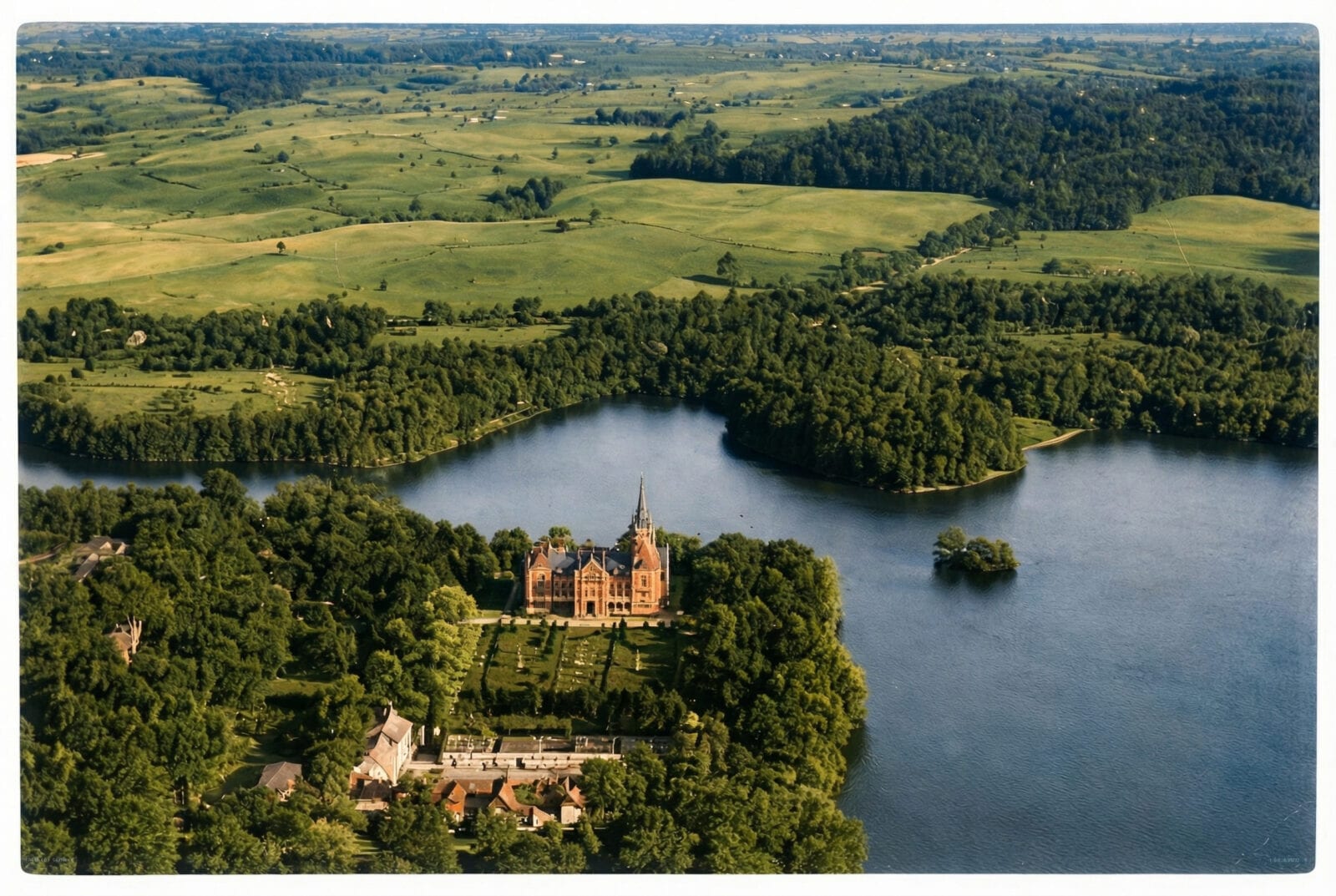
Lentvaris as an Earthly Paradise: A Park Where Landscape Became an Idea
In the late 19th and early 20th centuries, Édouard François André was one of Europe’s most prominent landscape architects, shaping a modern approach to the art of park design. His name resonated across France, Italy, and Germany, and today it is inseparable from Lithuania as well—specifically the parks of Lentvaris, Voke, Uzutrakis, and Palanga. Yet, among all these creations, it is the Lentvaris park that is considered André’s true masterpiece, a place where his ideas took on their fullest, boldest, and most complete form.
The very fact that a creator of such global stature came to Lithuania is astonishing in itself. It is believed that the authority, connections, and cultural stance of Count Władysław Tyszkiewicz played a decisive role here. This was no random commission, but rather a meeting of two worldviews—a man who perceived the landscape as a spiritual space, and an artist capable of turning this vision into a living form.
Upon arriving in Lentvaris, André did not simply "design a park"—he fell in love with the area. Lithuanian nature appeared to him as the ideal medium for a subtle dialogue between naturalness and human-made structure. Compared to his other works, Lentvaris park underwent the most radical transformations: the entire terrain was redesigned, slopes were excavated, and new perspectives were formed. However, all this was done not to showcase human power, but quite the opposite—so that the park would look not "newly created," but as if it had always been there.
André sought a sense of maturity. Therefore, not only were new plants planted here, but already growing trees and shrubs were relocated, carefully coordinating their shapes, heights, and foliage. The park featured about 50 species of trees and shrubs, of which roughly 20 were deliberately selected and adapted by André himself. It is no coincidence that small-leaved plants prevailed—so that the foliage would not overshadow the flower beds, views, and architectural accents.
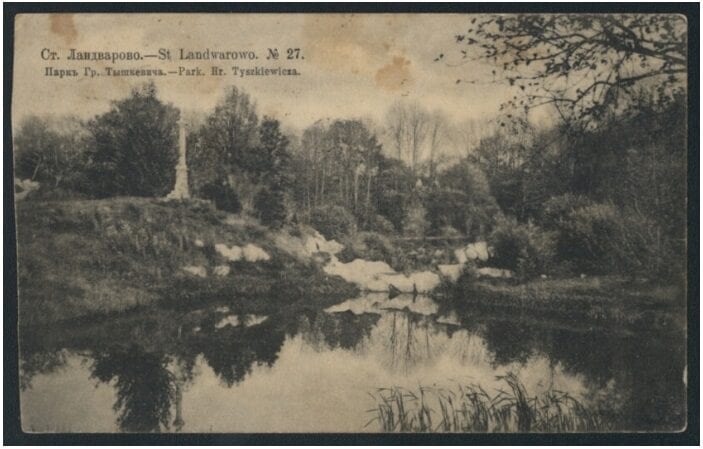
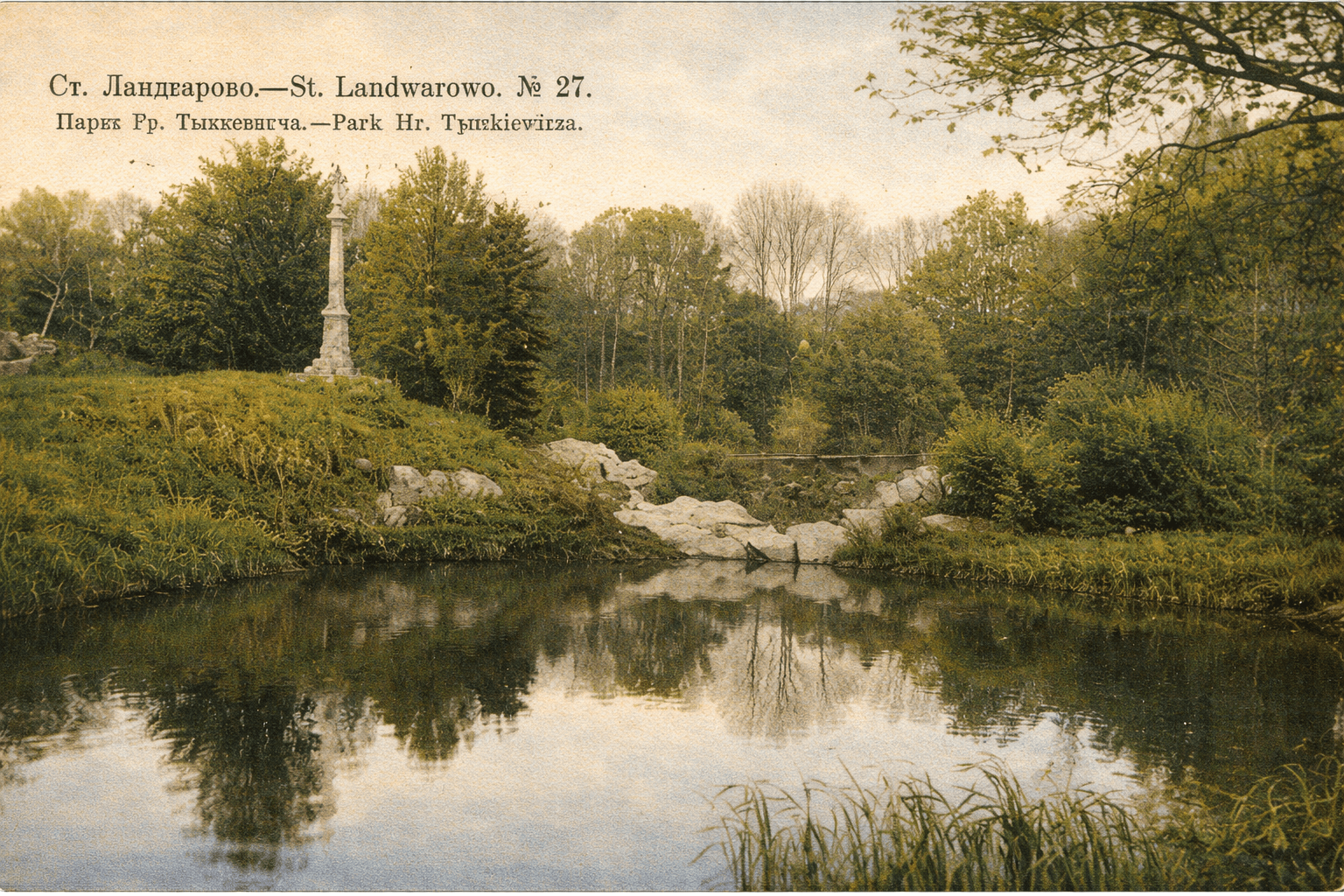
One of the most striking features of Lentvaris park is its system of artificial and natural rocks. Here, André created a kind of "mountain park": rock massifs, stone bridges, winding paths, steps, and steep shores reminiscent of Alpine landscapes. The architect himself emphasized that locations where artificial rocks can be formed so organically and convincingly are exceedingly rare in Europe. Lentvaris was a true landscape gem to him.
The park is also distinguished by a unique viaduct with an underground artificial rock, built from reinforced concrete and bricks. It is constructed so masterfully that an uninformed observer would find it hard to believe it is not a natural formation. Water is an equally important element. André created a complex, artistic system: three ponds located at different levels, connected by a cascading stream that falls from steep rocks, creating a sense of constant movement and life.
Lentvaris park was also interpreted as a spiritual space by researcher Vytautas Petrusonis, who saw in it the idea of an Earthly Paradise. According to him, elements such as the obelisk, the viaduct bridge with a grotto, the waterfall, or the so-called "philosophers' alley" were intended not just for walks, but for meditation, purification, and inner reflection. This perfectly aligned with André’s own worldview, which he summarized with the phrase: "Beauty is an active force for realizing eternal ideas."
This thought perfectly matched the spirit of Count Władysław Tyszkiewicz. He was a pacifist and an intellectual who disliked hunting, did not smoke, and avoided the "mandatory" aristocratic amusements of the time. Instead, he chose—and offered to others—walks in Lentvaris park, not only to admire the beauty but to think. To him, the park was not a decoration, but a part of his life philosophy.
Restoring Imagery with the Help of Artificial Intelligence
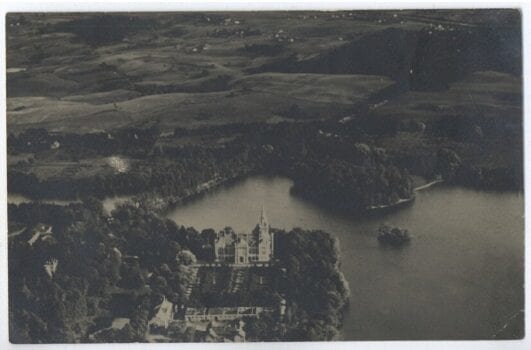
Today, more than a century later, the structure of Lentvaris park created by André is still considered exemplary and flawless. And modern technologies allow us to go even further: with the help of artificial intelligence, old, faded, and black-and-white photographs can be revived, colorized, and reconstructed so that we can see the park almost exactly as it was during the time of André and Tyszkiewicz. This provides an opportunity not only to study history but to experience it visually, as if briefly returning to a time when beauty was created as a conscious, living force.
- Giedre Petreikiene, Vilnius, Maple Alley
- The Édouard François André Park Route in Lithuania: A Tourist Route Guide. 2011, 32 p.
- Narkowicz, Liliana, The Tyszkiewicz Family of Lentvaris, manuscript, translated from Polish by Jolita Karczewska-Rus, 2018. Translated from: Narkowicz, Liliana. Tyszkiewiczowie rodem z Landwarowa, 2013.
- Petrusonis, Vytautas. The Significance of Cultural Context in Evaluating an Architectural Complex. Urban Planning and Architecture, 2010/34(5), pp. 252–261.