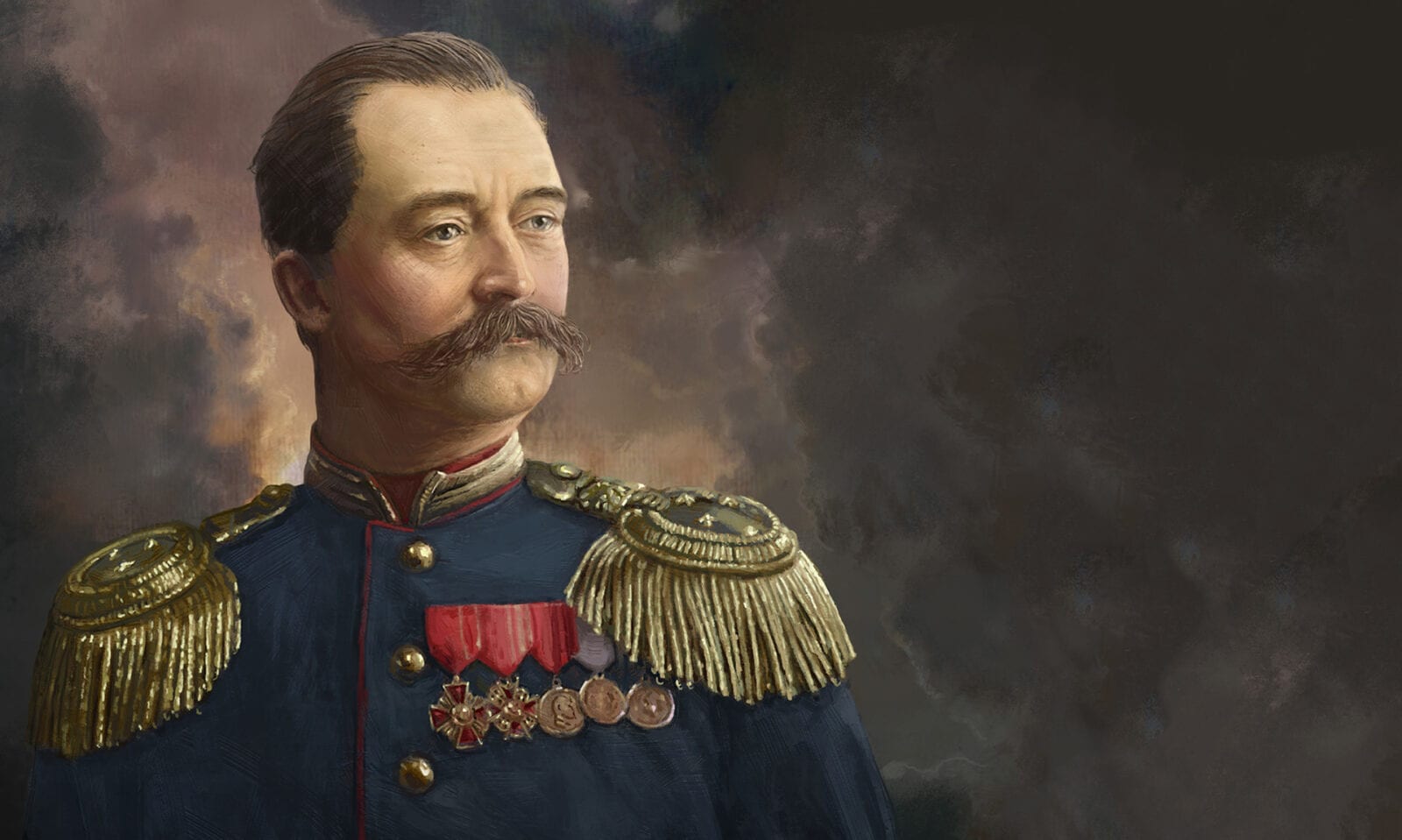
Józef Tyszkiewicz Turned the Manor into a Legend
An Early Loss of Parents and a "Russian" World of Youth
Józef Tyszkiewicz (1835–1891), like his brothers, was born in Lahoysk—a vast estate in present-day Belarus, inherited from Vasyl Tyszkiewicz, the ruler of Lahoysk and Berdychiv. However, his story began not with a peaceful childhood picture, but with an early void: his parents, Józef and Anna Zabiełło, died too soon, and the boys' fate was left in the care of strangers. When there are no parents at home, rules emerge. When warmth disappears, order takes its place.
The first serious authority figure was Adam Jocher, a prominent bibliographer and academic lecturer. He brought discipline to the upbringing of the Tyszkiewicz sons: more clarity, duty, and structure, and less sentimentality. Music, on the other hand, entered this palace as an entirely different world—for a time, Józef was taught by Stanisław Moniuszko himself, who even took up residence in the Lahoysk palace, a place filled with ancient relics and marks of history. Yet, for the youngest, Józef, these lessons did not become a profession or a calling. What he took from them was a love for home concerts, that special feeling when music is not a stage performance but an atmosphere—a background to life that remains even when life takes entirely different, rougher paths. When Jocher departed, the boys' education passed into the hands of randomly chosen tutors.
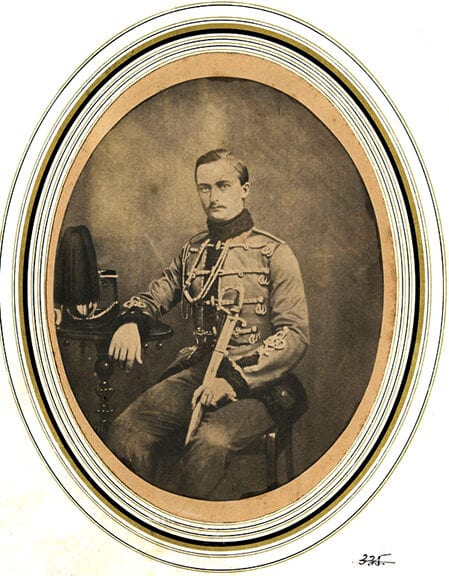
Józef, likely through his grandfather Michał, inherited a vivid imagination, a strong temperament, and an inclination toward military service. Therefore, his path led to St. Petersburg, to the Page Corps established there. The years of study were less about grades and more about an environment that shapes a person quietly but irreversibly. Józef grew up in a Russian world, had many Russian friends, and the spirit of Polishness and patriotism was not his daily air, but rather a distant family tale—something you hear but do not always understand. Thus, his subsequent choice seems logical: upon completing his studies, he accepted a military appointment in the Sumy Hussar Regiment in Vilnius, and soon became the adjutant to two successive Governors-General of Lithuania—first Bibikov (considered strict), then Nazimov (who was milder).
This chapter of his biography is important not merely as a career milestone. Józef lived in two realities. One was his native reality, with his family name, land, and tradition. The other was that of the empire, with its uniforms, orders, and career ladders. It is precisely from this duality that a type of person later emerges who can be surprising: sometimes loyal to the system, and sometimes suddenly—unpredictably—challenging it.
A Million Rubles, Three Brothers, and Different Destinies: Birzai, Voke, Palanga, and the Road to Lentvaris
The division of the family estates opened up a field of opportunities for Józef Tyszkiewicz, where he no longer needed to plan cautiously or live "according to circumstances." Józef, like his two brothers, inherited a million rubles from his uncle Jan, the first ordynat of Birzai. This was no symbolic inheritance, but serious capital that allowed him to act immediately, broadly, and independently.
Land was also added to this: in the Ashmyany–Vileyka area, he received Izabelin—about 89 voloks of arable land, 22 voloks of meadows, and 49 voloks of forests, bordering the Tyszkiewicz estates in Valozhyn, the former Maladzyechna county, and Lebedziew.
1 volok ≈ 21.36 hectares
He also inherited Palanga in Samogitia—at that time still a quiet, little-known fishing village—as well as other large, mostly forested territories in Lithuania and Polesia. However, the real story begins not with the size of the plots, but with what each brother chose to do with this inheritance.
The eldest brother, Michał, a very tall, warm, and open man with a long brown beard, received the well-managed Birzai ordynacja in northern Lithuania. He had no knack for farming and did not even seek one. Instead, Michał became a passionate archaeologist and collector: he devoted a large part of his wealth to ancient artifacts, sculptures, jewelry, and gold coins. He was drawn not to daily management, but to the thrill of discovery. He spent much time abroad—on scientific and educational journeys to Nubia and Egypt, archaeological excavations in Italy and North Africa, as well as exotic hunting trips. He rarely visited Birzai, and his connection with the family was more episodic than constant.
The middle brother, Jan Witold Emanuel, chose an entirely different direction. He received Voke—a large, strategically convenient estate near Vilnius, encompassing 4,735 dessiatins of land. In 1860, on the foundations of the old house, he built a representative palace, its architecture reminiscent of the Łazienki Królewskie. Classicist figures created by the sculptor Kucharzewski rose above the pediment, and the entire ensemble testified not only to wealth but also to an ambition to create a cultural center. At the request of his wife, Izabela Tyszkiewicz, who was renowned for her beauty, Jan moved the main residence closer to Vilnius. From then on, the Voke palace gradually turned into a repository of art and history: artworks and tapestries were amassed here, including an 18th-century "Verdure" with the Pociej coat of arms, originating from the Ludwik Tyszkiewicz Palace in Vilnius, along with other valuable historical items. Voke became not just a place to live, but the representative face of the family.
Against the backdrop of these two brothers, Józef's choice seems more impulsive, more theatrical, but no less deliberate. He bought a somewhat neglected, yet picturesquely forest-surrounded 17th-century castle in Landwarów—present-day Lentvaris—from the two daughters of Marshal Dąbrowski. Along with it, he acquired land, forests, and folwarks: Piotuchowo, Karpiówka, Ustronie, and Raczkuny. The name "Landwarów" itself was already steeped in tales at the time. Locals said that these lands once belonged to a German named Warow, hence the phrase "Land von Warow"—Warow's land, from which the name Landwarow (Lentvaris) originated.
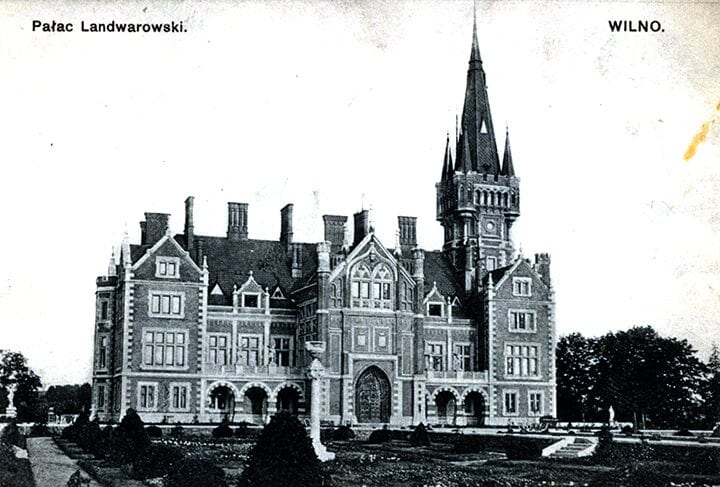
The geographical location of this place was almost ideal: just 18 kilometers to Vilnius, 7 kilometers to Trakai, and only 4 kilometers to Voke. A wide forest avenue connected Lentvaris to his brother's estates, and the road from Vilnius itself sounded like an itinerary of the city's life at the time. One would depart from the Tyszkiewicz Palace, which belonged to his uncle Benedykt—the master of Raudondvaris Manor—at the intersection of Zawalna and Trakai streets. The road then led through Pohulanka, past the classicist Napoleon's house, where a toll had to be paid. Beyond Paneriai and the Paneriai Hill, which marked the city limits, the traveler would roll onto a wide, sandy highway from the era of Catherine II, branching into three directions: to Kaunas, to Baltoji Voke, and straight to Lentvaris and Voke. Along the way stood a Baroque chapel—built by the Jesuits, renovated in the 18th century by Princess Ogińska, and considered miraculous. During the 1831 uprising, a Russian headquarters was located here, and the oldest residents of the area told of an attack by Polish uhlans, when at a crucial moment, clouds of sand and dust whipped up by the wind unexpectedly blinded the Russian cavalry. Traveling such a road does not lead to an ordinary manor. It is a road to a place where every turn already holds its own memory, and the space itself demands a grander scale from the very first moment.
Cossacks, Bandits, and Three Bearded "Trotters": The Era of Lentvaris Excesses and a Promise to Stop Drinking
Upon acquiring Lentvaris, Count Józef Tyszkiewicz immediately settled in his new residence and plunged into a bustling, public, and intense life, constantly oscillating between the manor and Vilnius. His official duties frequently called him to the city, and his high rank in the military hierarchy of the Russian Empire provided another exceptional advantage—he was assigned twenty-five Cossacks, excellently trained horsemen. Józef allowed them to bring their wives, so Lentvaris gained not only an armed squad but also a kind of closed, loyal community: twenty-five Cossack women, strong and prepared for a life not of comfort, but of constant motion.
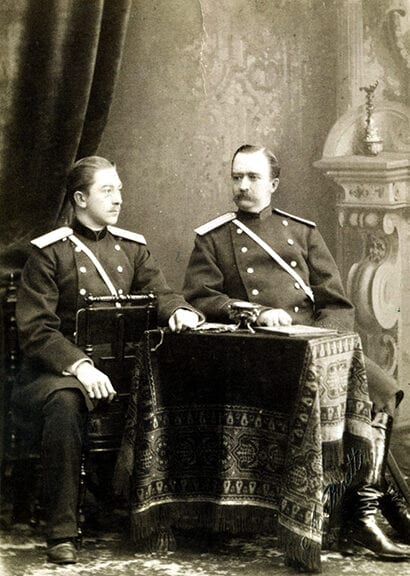
This was a force that could be relied upon. And Józef was a man who disliked tranquility. With his vivid imagination, fiery temperament, and constant need for action, he did not avoid situations—he created them. Tales of robber dens near Paneriai Hill enticed him not as a danger, but as a challenge. The area still held vivid memories of Piekarski, who around 1809 had gathered a gang of several hundred men and attacked merchants traveling to Vilnius. This man was no ordinary highwayman: he spoke several languages, was a master of disguise, robbed even titled travelers, and the army had to fight him as a regular enemy. Although Piekarski was eventually captured, the Paneriai surroundings were considered dangerous for a long time.
Józef, as if consciously wanting to rewrite this reputation, clashed with a group of twenty bandits alongside his Cossacks. This was no symbolic show—the confrontation was serious, though without major casualties. News of this event spread quickly, and the young master of Lentvaris Manor became a character people talked about. His appearance only strengthened the legend: tall, slender, with military-short brown hair, blue eyes set in a dark complexion, an excellent horseman, always upright, proud, and conspicuous. Such people do not go unnoticed in a city—they become a spectacle.
His appearances in Vilnius caused an even greater sensation. In St. Petersburg, Józef bought a troika of magnificent trotters and rode them through the city even to the nearest streets—with pomp and obvious demonstration. This irritated Governor-General Nazimov, who ordered the horses to be sent to the countryside. The order was carried out: the trotters departed for Lentvaris. However, Józef was not a man to accept a ban as a boundary. He took it as an invitation to improvise.
The Count hired three bearded, strong men, paid them generously, and... harnessed them to a sleigh. In the middle was one with a brown beard, and on the sides, two with black ones. With such a "harnessed" troika, he began riding around Vilnius. This time, the authorities' patience ran out—the consequences were more serious than previous reprimands. Yet Józef's nature remained unchanged: he did not know how to live without testing boundaries. Dzhigitovka—leaping over carriages—or other dangerous stunts were not random episodes for him, but a way of life. And so fame was born: not from a single act, but from consistent repetition. Today—bearded men instead of horses; tomorrow—another story that the city would pass from mouth to mouth.
However, one episode changed everything. After a grand feast in Vilnius, servants found Józef completely drunk on the street and brought him home. Upon waking, he faced a feeling he had never experienced before—not fear, nor shame before others, but a deep shame before himself. Such a state was unbearable for a man accustomed to controlling situations. At that moment, he swore never to touch alcohol again for the rest of his life. The promise was not symbolic: from then on, even at the most formal dinners, he was served lemonade instead of wine.
This was no minor detail. It was a turning point. A man who until then seemed to live like a gambler suddenly set a rule for himself—and stuck to it. Such rules do not change a character, but they focus it. And from that moment on, the excesses in Józef's life began to recede, giving way to decisions of a different magnitude.
The Shadow of the Uprising, a Wife's Principles, and a Slammed Door on a Career: Leaving the Army and the Road to Paris
Times were becoming turbulent, and even the most vivid personal stories began to sound different when political tension started to crackle all around. Dissatisfaction with imperial rule was growing throughout the land. In Warsaw and Vilnius, under the guise of agricultural society conventions, the Polish nobility gathered in ever-increasing numbers. Two factions were forming: the so-called "Whites," who believed that independence could be achieved gradually—through reforms and compromise with St. Petersburg—and the "Reds," who urged radical action. An uprising was no longer just a possibility, but a premonition. In Lithuania, rebel squads were secretly being rallied by Zygmunt Dołęga-Sierakowski.
At this crossroads, Count Józef Tyszkiewicz chose an unpopular stance. He was a resolute opponent of bloodshed and reprisals. Having graduated from a Russian military school and served in the Russian army, he perfectly understood the military might of the empire and harbored no romantic illusions. In his eyes, a handful of idealists could not defeat a regular army. He saw not only the idea but also the cost—young people dying pointlessly, who, in his view, could serve their homeland in other, long-term ways.
The manifesto issued by the Tsarist authorities on March 3, 1861, which promised land to the peasants and was intended to weaken the rebellious mood, had the opposite effect. Unrest broke out in the villages. The peasants were outraged: corvée labor was to remain for another two years, redemption payments were high, and the right to buy out land was limited only to a house with a garden and a portion of land—usually smaller than what they had previously worked. Many expected the magnates' latifundia to be divided. When this did not happen, disappointment turned into open anger.
The unrest began at the Iwje estate, which belonged to Countess Zamoyska. Governor-General Nazimov ordered the use of force, but Józef Tyszkiewicz stopped him and promised to handle the situation himself. At ten o'clock in the morning, leading a squad of Cossacks, he entered the Iwje market square: swords remained in their scabbards, but whips rose into the air. The crowd scattered—those who could fled down side streets, the rest fell to their knees, randomly "pointed out" alleged instigators, received lashes, and were sent home. Order was restored quickly, but this episode became a moral breaking point. Patriotically minded Poles condemned him. Hieronim Kieniewicz, who later became Józef's brother-in-law, presented a plan for sabotage in Russia to the Vilnius Committee, proposing to mobilize the peasant masses. The plan was accepted, and Józef, although he did not support the uprising himself, allocated funds for this strategy. This is yet another of his internal paradoxes: he rejected the romance of the uprising, but supported actions that, in his eyes, fit the political logic of the time.
Personal decisions matured alongside political ones. The family—uncles and older brothers—decided that Józef needed to marry. The Horwatt family was deemed suitable. Aleksander Horwatt, the future bride's father, had served for many years as the Marshal of the Kiev Governorate, was a supporter of the "Whites," a resolute opponent of the uprising, and a universally respected patriot. The mother, Klotylda Wołodkowicz, had just returned with her three daughters from a year-long trip across Europe. It is said that she brought back so many clothes and fabrics from Paris that customs officers did not believe it was for non-commercial purposes and imposed a massive duty.
Józef was sent to Barbarów—the Horwatt estate in Polesia, by the Pripyat River—to be introduced to the youngest daughter, Zofia. She was no beauty: somewhat plump, with a full face, thin hair tied in a bun, and caring little about her appearance. At first, Józef hesitated, but Zofia's bright character, calmness, and sincerity gradually won him over. In 1861, the wedding took place in Barbarów, after which the newlyweds left to live in Lentvaris.
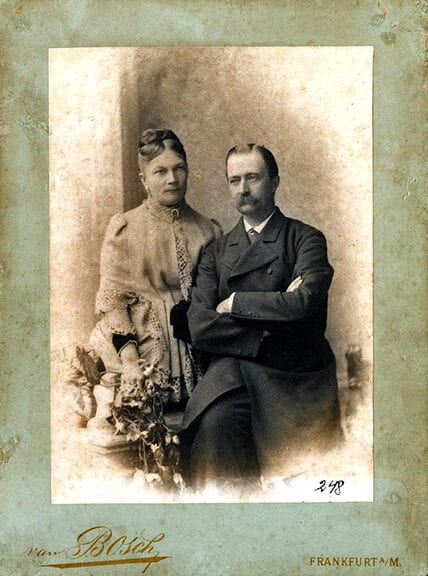
Zofia sought to create a Polish, Catholic home. She was offended by her husband's Russian uniform and Russian carriage. Wanting to appease her, Józef dressed the coachman and servant in Kraków-style clothes and drove his wife to Vilnius in such a "Galician" turnout. However, the police quickly noticed the forbidden national attire: the servant and coachman were arrested and punished with lashes. This event became an explosion. Józef went to Nazimov, demanded an explanation, tore off his officer's insignia, threw them along with his sword at the general's feet, and declared that he was resigning from the service. Slamming the door, he left, perfectly aware that this could end in a court-martial and the death penalty.
For several days, Józef and Zofia waited in Lentvaris, not knowing what would happen next. However, Nazimov later denied this conflict even in St. Petersburg, claiming that if such an event had occurred, the adjutant would have been shot long ago. This crisis, along with his wife's consistent arguments, determined the final decision: Józef resigned from the Russian army. Wanting to avoid the uprising, which neither of them supported, they left for an extended period to Paris—a city that at the time symbolized not only culture but also the opportunity to live away from imperial conflicts.
Children, Estates, Water, and the Railway: How Lentvaris Became a Project, and Zofia Its Iron Bookkeeper
In this family's history, personal decisions never ended with feelings or domestic life. They almost immediately turned into land, buildings, water channels, and long-term decisions whose consequences were visible for decades. The family grew quickly and unevenly: in 1862, the first son, Józef, was born, who died at just four years old. The second son, Aleksander, was born in Paris. Władysław, Antoni, and Józef saw the world in Lentvaris, while Maria, Feliks, Zofia, and Helena Klotylda were born in Samogitia. Alongside these children, the family's life also included those born before the marriage: it is said that Countess Zofia actively and consciously contributed to the upbringing of all of Józef's children. After the death of their first child, the Tyszkiewiczs adopted Tekla—Józef's exceptionally beautiful daughter, who was later married to Stanisław Rzewuski.
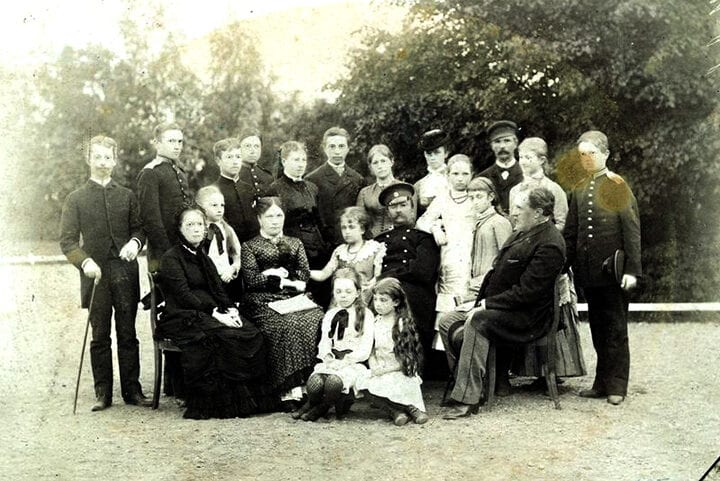
This was not a romantic, intimate family. It was a large, complex structure, and therefore the goal was formulated not by feelings, but by responsibility: to ensure a position and wealth for each child befitting their lineage. It is precisely from here that the transformation of Lentvaris from a manor into a project begins.
The estate was managed on a grand scale and without delay. In a short time, modern farm buildings, mills, a brickyard, and two large brick stables—separate for draft and riding horses—were erected. A large bronze sculpture of a horse was raised above the entrance gates—not a decoration, but an open sign of the master's passion. However, the most important things were happening not on the facades, but in the terrain. The environment of the Lentvaris homestead was fundamentally reworked. A deep ravine, above which the 17th-century castle stood, was turned into the large artificial Lake Lentvaris. Water was brought in through a six-kilometer-long masonry canal from Lake Galvė, whose shores belonged to the manor. Dams regulated the water level, forming the new Lake Bałcyk near the folwark of the same name. As the water flowed down, it turned a nail factory and fed yet another new lake—Malowanka.
Not everything went without mistakes. One decision resulted in the accidental flooding of a valley with a growing forest, and later those trees hindered fishermen from pulling their nets. Yet at the same time, other opportunities opened up: the waterway to Trakai, to the islands of lakes Galvė and Skaistė, allowed for grand excursions and night picnics with torches. Lentvaris became not just a place to live, but a scenography—a landscape surrounded by forests and wild lakes.
This expansion coincided with the rapid development of railways. In the mid-19th century, new networks connected St. Petersburg with Warsaw, Kaunas, Liepāja, and the German-Russian border in Virbalis. Lentvaris became an important junction. Józef offered the authorities a solution that at first glance seemed unexpected: he would give away the necessary land plots for the railway free of charge and build the station, workshops, and workers' residential houses at his own expense—in exchange for the right to buy land from Russian citizens. The authorities agreed. This right became an instrument that Józef used to the maximum. Since Poles were forbidden to buy land, many estates ended up in his mortgage—mostly from auctions due to debts or after confiscations carried out following the 1863 uprising. Thus, the estates grew: Karaciszki, Miecowszczyzna, Podumbla, Zośle, Korsaki, Dowgierdziszki, Buraki, Zakrzyże, Zatrocze, Granopol, Dębina, and others.
These estates were very different. Karpiówka was a small manor with a brickyard, vegetable gardens, orchards, ponds full of carp, an administrator's house, and a 17th-century brewery; a bronze urn from an ancient grave found here during construction was donated by Józef to the Eustachy Tyszkiewicz Museum in Vilnius. Korsaki and Zośle formed a single agricultural complex, well-managed, with fish ponds; in Korsaki stood a small white-plastered manor with columns, while in Zośle, by the lake, a wooden effigy of Pojata, dating back to the early 13th century, still stood. Granopol was confiscated, its palace razed to the foundations, just like Dębina, which was forcibly sold under the decree of Tsar Alexander III. Zatrocze by Lake Galvė, with a view of the Trakai Castle walls, was shrouded in a legend about St. John of Nepomuk and the belief that until the destroyed statue was returned, the lake would claim one life every year.
Alongside these scales, a very human division within the family also emerges. Countess Zofia had an exceptional sense for numbers and a firm hand in bookkeeping. Józef, who had pierced his eye in childhood and had reading difficulties, relied more on technical solutions, intuition, and experiments: ponds, dams, new schemes. It was joked in the family: "Zofia increases the wealth, Józef spends it." But in reality, it was an operational model: he generated ideas and pushed projects, while she stabilized and managed them. It is no coincidence that when an administrator once arrived to present a report, Józef simply retreated to the garden, leaving everything to his wife, saying: "I am foolish, my wife is smart—let her handle it."
The structure of the staff also showed the scale: the 1866 register mentions doctors, governesses, an architect, a cashier, a secretary, a provisions clerk, foresters, guards, and in winter—a stove heater. The Countess, despite all this structure, personally took care of the house, the children, and the guests. And there was no shortage of guests—due to the railway junction, people would "drop by for a moment" and stay for a month. After ten years of such a life, it became too much for Zofia. Thoughts began of retreating as far away from the junction as possible. Józef even considered emigration, studied maps, and gathered information about countries with a similar climate—Canada was considered. However, Zofia opposed this, considering it a duty to remain on their land. Ultimately, the plan was rejected. In 1870, Józef bought the Kretinga estate near the inherited Palanga from the Governor-General of Vilnius, Count Zubov. It was decided to move the main residence there—and the Lentvaris phase gradually began to turn into history.
Sources and Recommended Literature
- Notes of Zofia Tyszkiewicz Potocka, National Library in Warsaw.
- Archival materials in the Vilnius City Archive.
- Memoirs of Helena Tyszkiewicz Ostrowska, manuscript copy from the collections of Hanna and Adam Tyszkiewicz.
- Interview with the administrator of the Tyszkiewicz Landwarów estate (tape recording, 1970s).