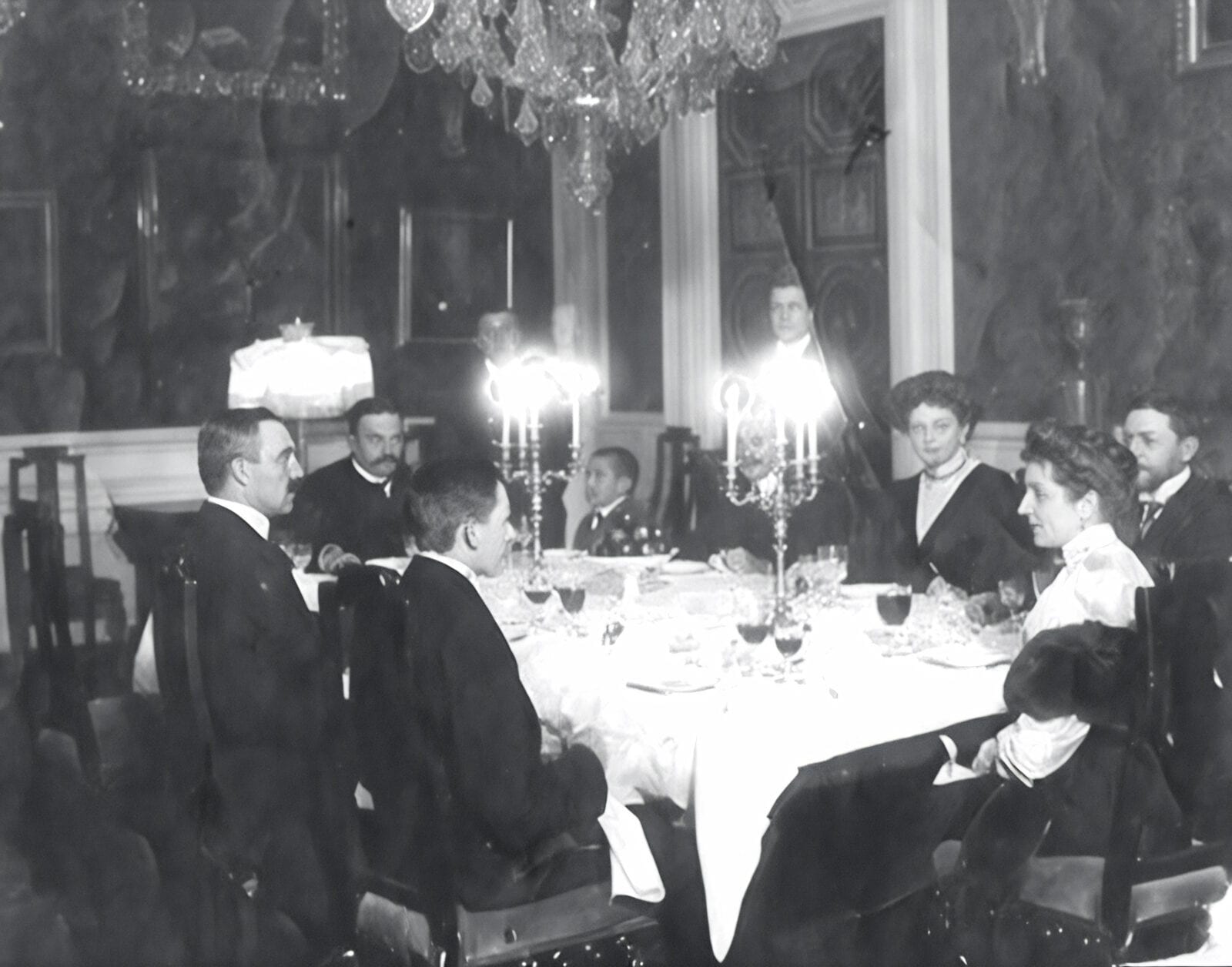
Christmas with the Tyszkiewicz Family
As Christmas approaches, it is impossible not to mention the holiday traditions at Lentvaris Manor, located near Vilnius. The Tyszkiewicz family, owners of this manor since the mid-19th century, had been Polonized for several centuries—a result of their service at the Polish royal court and their Polish wives. In the territory of present-day Lithuania—in Biržai, Raudondvaris near Kaunas, Užutrakis, Kretinga, Kaišiadorys, Oranai, Vokė, and Lentvaris Manor—they celebrated according to Polish traditions.
A large Christmas tree adorned with baubles would be set up in the grandest drawing room. The family would sing carols, share the Christmas wafer, exchange gifts, attend Midnight Mass, and, of course, serve 12 dishes—a number that remained the standard in the manors of landowners and aristocratic salons to this day. Townspeople and the lesser nobility aimed for 9 dishes, while peasants typically had 7.
From a letter written by the young Countess of Lentvaris after the war to the son of a former manor servant, we know that the Christmas Eve table of the peasants in the Vilnius region was modest: the Christmas wafer, dried fruit compote, kissel, sauerkraut, peas, dried mushrooms, beetroot, and herring. For Christmas Eve, the Tyszkiewicz family would gift fish from the manor's lakes to the estate administrator, accountant, cashier, head of the stables, head gardener, and the Count's personal carriage driver. The manor's fishermen and their supervisor, who was responsible for fishing and the cleanliness of the water bodies, received fish as part of their monthly allowance.
Rose Tyszkiewicz, daughter of Vladislovas, recalled:
"On Christmas Eve, there was a great deal of bustle and excitement from the very morning. It was clear that the wardrobe maids would spend more time than usual brushing our hair and dressing us in our Sunday best with little white collars. We did not take part in decorating the tree (which saddened us greatly), as it was meant to be a surprise. Every year, the decorated tree looked completely different. When the doors to the brightly lit drawing room were finally opened for us, beautifully wrapped gifts would already be lying under the tree, while we—my sister, my brothers, and I—would anxiously wonder if anyone was going to get a birch rod, a practice that seemed common in all Tyszkiewicz households."
Although we were kept hungry all day (our nanny explained that this was to give our stomachs a rest), we did not greedily devour the food at the Christmas Eve table. The meal featured red borscht with mushroom croquettes, carp in aspic and Jewish-style carp, dumplings with cabbage and porcini mushrooms, herring in various forms (which everyone still loves to this day), and a poppy seed and dried fruit strudel. For the little ones, there was sweet almond soup and tiny marzipan figures—stars, little mushrooms, suns, moons, and angel wings.
However, what excited us children the most was spotting the first star in the sky through the dining room window, as it signaled the moment our father would present gifts to us and our mother. Mother usually received gold jewelry, a live horse, or a lap dog—she accepted no other kinds of gifts. We received mechanical toys brought from Germany or ordered from France: most often, these were ladies beautifully dressed like our mother, aunts, or grandmother, gentlemen sitting in wide armchairs or on rocking horses, as well as a working maid who, at the push of a button, would start dusting with a cloth, while an old gentleman with a mustache sitting nearby, who looked just like our grandfather Joseph Tyszkiewicz, would roll his eyes.
On Christmas Eve, even the grandest lady had a duty to step into the kitchen, if only for a moment—not just to check the preparations for the most important dinner of the year, which often included guests from afar, but also to symbolically grind the poppy seeds, which by tradition were meant to bring the family luck in the coming year, or to shape a small marzipan ball as a symbol of household prosperity. Fish was fried, boiled, and prepared in a separate room, as such smells were not welcome in the palace's drawing rooms.
Countess Maria Krystyna Tyszkiewicz, the mother of the author of the aforementioned memoirs, had no interest in cooking—and at the time, she had no need to be. The Tyszkiewicz family employed two chefs and a host of assistants both at Lentvaris Manor and in Warsaw, where they would spend their winters. However, Christmas Eve was celebrated in both places, as the owner of Lentvaris periodically had to not only be present at the estate but also organize hunts, which, it is said, he personally disliked.
The social elite—first the knights, later the nobility and aristocracy—adhered to traditions and established duties. Every landowner engaged in hunting. In earlier centuries, there were no factories supplying meat and furs, so people had to provide these for themselves. By the second half of the 19th century, during the industrial boom, hunting was no longer a vital necessity among the landowning classes but had instead become a part of social and cultural life. Continuing chivalric traditions, it became a popular pastime for wealthy owners of land and forests. Hunting on Christmas Eve was almost an obligation; no one was excused from it, not even the sick or the elderly. They would be brought in by horse-drawn carriages, and sometimes even carried to the campfires on stretchers.
The Christmas Eve hunting campfire was a magical place that united everyone once a year. If the hunt did not take place near a forester's lodge or a hunting cabin, tables and benches brought by wagons from the manor would be hastily set up in a clearing. There was also a special set of tableware—made of brass so it wouldn't chip during transport: spoons for bigos, large and small knives, goblets, and plates. After the hunt, all quarrels and anger had to be forgotten; there was no talk of settling scores or discussing problems on that day. One had to be kind, warm-hearted, and cheerful so that worries would not carry over into the coming year. However, closing business deals, for example, was very much a part of the tradition.
As Stefan Tyszkiewicz, Zofia's brother, recalled, Christmas Eve hunts took place early in the morning and did not last long, ensuring everyone could return to their families in time for Christmas Eve dinner. Custom dictated that the hunt should end once the number of animals bagged equaled the number of hunters. During the interwar period, the game consisted of foxes, wild boars, hares, and wild birds. However, the old drawing room of their grandfather Joseph proudly displayed 19th-century hunting trophies—a bear skin with the head attached, moose antlers, and a stuffed wolf. A wolf was a rare decoration in manor interiors, as its fur was typically used to sew light and warm coats for the hunters.
"It didn't matter," Stefan recalled, "who hunted what on that day, because the spoils were shared among everyone." Part of the game went to the manor's kitchen, and part was given away as gifts. Christmas Eve at the palace was a day of fasting, but on December 25th, no resident of Lentvaris could go without meat. Roast hare with carrots or wild goose with baked apples and plums was a true delicacy. Sometimes, an entire wild boar would grace the table—especially during large family gatherings or visits from distinguished guests, as it was important to make an impression. And our parents certainly knew how to do that, and had the means to do so.
Everyone loved the homemade Lentvaris starka, which was drunk on the first day of Christmas. On Christmas Eve, only red wine was served. After the hunts, during the picnic, they drank homemade liqueurs infused with honey and herbs, while the beaters and support staff were given vodka. In winter, after the hunts, they ate bigos, which on Christmas Eve was prepared without meat. Whatever the landowners did not finish went to the so-called "second table," meaning the leftovers were eaten by the hunt organizers and foresters. The servants received bread, pickled cucumbers, bacon, and sausage. On the occasion of the most important hunt of the year, the clergyman whose blessing commenced the hunt would grant a dispensation from fasting.
The Tyszkiewicz family spent the first day of Christmas in their family circle or making brief visits to their closest acquaintances. They exchanged small gifts, told jokes and amusing anecdotes, and shared their hunting impressions. There were games for the children, the adults, and the whole family. In the evening, everyone gathered by the fireplace for a shared reading of fairy tales or winter stories.
The second day of Christmas at Lentvaris Manor was spent "intellectually." Count Vladislovas (1865–1936) was very different from his father—a professional military officer—and his brothers. He was afraid of horses, avoided hunting, and did not even own a dog. Had he been able to, he would have ignored the estates and finances entirely, choosing instead to travel and spend his money on works of art. He adored Italy, spoke Italian, and was a passionate collector of paintings, furniture, carpets, lamps, clocks, and precious trinkets, especially antique Russian artifacts, which frequently drew him to places like St. Petersburg. Thus, there was always plenty to show guests at home and much to be proud of.
After rebuilding his father's palace at Lentvaris Manor at the end of the 19th century, Vladislovas Tyszkiewicz decorated the interior in an Italian style—he brought in entire railway cars full of fixtures, including doors, handles, and fireplaces, not to mention furniture sets, tapestries, and sculptures. Until the First World War, the representative rooms included the Red Drawing Room (for banquets), the English Drawing Room (for socializing), the Blue Drawing Room (for women's gatherings) with a boudoir section, the master's study with its collection of rare objects, a library with a reading room, and an ornate dining room adorned with marble Roman busts on gilded oak pedestals and valuable biblical paintings, including "David and Goliath."
The greatest interest was drawn by the multitude of sculptures—Emperor Nero, Bishop George Tyszkiewicz, Apollo, Flora, the Four Winds (North, South, East, West)—and paintings by Italian, French, and Flemish masters. The walls of the drawing rooms were graced with works by François Gérard, Raphael, Giambattista, Anthony van Dyck, Pietro Antonio Rotari, Salvator Rosa, Nicolas de Largillière, Guido Reni, Gerrit van Honthorst, Joachim Beuckelaer, Mignard de Vieux, and others. Among Polish artists, the most extensively represented was Kazimierz Mordasewicz, who frequently stayed with the Tyszkiewicz family to fulfill private commissions, primarily portraits.
The list of paintings that remained in the children's memories is impressive: The Blessed Virgin Mary with the Infant Jesus and St. John, Lady with a Turban, Portrait of a Youth, Head of Christ with the Crown of Thorns, The Death of Abel, The Four Evangelists, Knight in Armor, Lady Playing the Harp, The Descent from the Cross, Madonna with a Flower, Madonna and Child, Group of Children in a Rose Garden, and many others. Thus, there was much to boast about to guests—both their knowledge of art and their extensive connections with renowned Italian dealers and collectors.
Liliana Narkowicz
Dinner in the palace dining room – December 1913.
Photo from the Tyszkiewicz family archive.