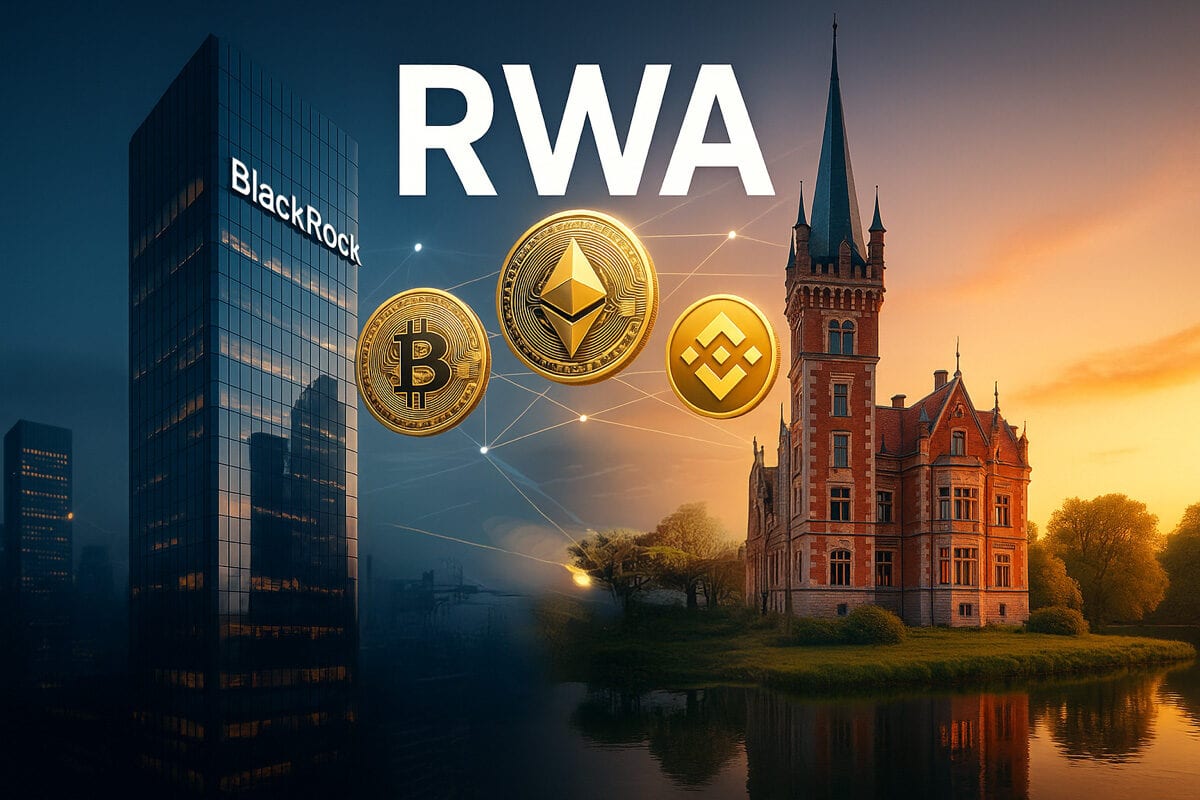
The Rise of RWA: From Skyscrapers to Castles – Why Tokenisation Is the Next Trillion-Dollar Opportunity
Imagine this. You can own a share of the Empire State Building. Or a vineyard in Bordeaux. Or a castle in Lithuania that has stood for centuries, its walls whispering stories of nobles, wars, and revolutions. Not by being a billionaire. Not by joining an exclusive club. But by holding a digital token in your crypto wallet.
This is not a fantasy. It is the future that Real World Asset (RWA) tokenisation is unlocking. And it is happening right now, at a scale that is hard to overstate. BlackRock, Franklin Templeton, Binance – the giants of finance and blockchain – are betting that tokenisation will not only be the biggest Web3 trend but the bridge that finally connects traditional finance with blockchain.
But here’s the problem. The first wave of RWAs is… boring. Tokenised bonds. Treasury bills. Invoices. Fractionalized real estate in glass skyscrapers. Yes, they bring liquidity and access. But they don’t stir the soul. They don’t make people dream. They don’t make headlines outside the financial press.
The second wave will. Because the next generation of RWAs is not just about numbers. It is about meaning. About culture. About owning a piece of history, a slice of heritage, a share of something you’d proudly show your friends.
And this is where castles come in.
The Boring Beginning of a Trillion-Dollar Wave
Let’s start with the numbers.
According to Boston Consulting Group, the tokenisation of illiquid assets could become a $16 trillion market by 2030. BlackRock’s CEO Larry Fink has said publicly: “The next generation for markets, the next generation for securities, will be the tokenisation of securities.” Franklin Templeton already has over $300 million in assets tokenised on-chain.

Binance, Coinbase, and BNB Chain are running initiatives to spotlight projects that can turn the RWA vision into reality. And they are doing it for one reason: demand. Institutions want efficiency. Retail investors want access. Everyone wants liquidity.
It makes sense to start with bonds and treasury bills. They are safe, measurable, and regulators like them. But let’s be honest – they are not what will capture the imagination of millions.
From Numbers to Meaning
Now imagine this: instead of just buying a token tied to a 6-month U.S. Treasury yield, you could buy one linked to the rental revenue of a restored 19th-century Gothic manor in Eastern Europe.
Instead of just holding a tokenised bond, you could own part of a Tuscan vineyard producing Chianti Classico, or a villa on the French Riviera, or a castle in the Baltics that hosts international conferences, retreats, and educational experiences.
This is the emotional wave of RWAs. And it is coming faster than people expect.
Because money follows meaning. And meaning attracts communities, not just investors.
Why Castles Make Sense
Some people may laugh. “Castles? Really?”
But think deeper. Castles, vineyards, heritage estates – they combine everything RWAs promise in theory:
• Tangibility – these are physical, revenue-generating assets.
• Scarcity – there are only so many castles, so many UNESCO sites, so many heritage manors.
• Emotional value – people are proud to own them, even in small fractions.
• Cultural branding – unlike an office block, a castle has a story.
This is why tokenisation should not stop at financial assets. It should move to cultural assets – things with history, symbolism, and the power to attract communities.
And that is exactly what is starting to happen.
The First Tokenised Castle
Take Mind University, a project backed by the restoration of Lentvaris Manor, a 19th-century neo-Gothic palace in Lithuania.
This is not a concept. The manor has already received €673,000 in EU grants for restoration, and over €4 million invested by its current owner. Its park, designed by French landscape architect Édouard François André, has received €1.5 million in EU funding for revitalization.
But here’s the twist: Mind University is not just restoring the castle as a museum. It is turning it into a tokenised cultural and educational hub.
That means:
- You can hold tokens tied to the castle’s future revenue streams – events, retreats, hotel rooms.
- You can participate in its community governance through a DAO.
- You can earn tokens by engaging in its gamified learning apps – like defending the manor from zombies in a Telegram game or exploring its VR version in the Manorverse.
In other words: a historic manor becomes a blockchain-powered university, part museum, part cultural center, part metaverse, and part DAO-owned Web3 startup.
This is not boring. This is not abstract. This is the kind of RWA that makes headlines.
Why Investors Should Care
For investors, the appeal is clear.
- Diversification – Most RWAs today are financial instruments. Castles and cultural landmarks diversify exposure.
- Scarcity premium – There are thousands of bonds, but only a few hundred tokenised castles could ever exist. Scarcity drives long-term value.
- Multiple revenue streams – Unlike a bond, a castle can generate money from events, hotels, courses, memberships, apps, tourism, and branding.
- Community network effects – People don’t gather around a bond. They do gather around a castle, a heritage project, a university of the future.
In short: tokenised castles are both an investment and a story. And in markets, stories are often what create outsized returns.
From Harvard Endowments to Tokenised Universities
There’s another layer here that makes Mind University stand out.
Universities are already one of the world’s biggest asset classes. Harvard has an endowment of over $50 billion. Stanford has $36 billion. Oxford and Cambridge are worth billions in real estate and assets.
But all of these are closed clubs. Ordinary people cannot buy a piece of Harvard. They can only pay to study there.
Tokenisation changes that. Mind University is showing a model where students, gamers, academics, and investors can co-own the university itself. Where the line between participant and shareholder disappears.
This could scale far beyond Lentvaris Manor. Imagine tokenised universities springing up in castles, villas, eco-campuses across Europe, Asia, Latin America. Each one both a real-world revenue generator and a cultural symbol.
That is how categories are created. And categories are where fortunes are made.
The Trillion-Dollar Picture
So let’s zoom out.
The first wave of RWA tokenisation is making markets efficient. But efficiency alone does not move culture. The second wave – castles, vineyards, cultural assets – will bring RWAs into the mainstream consciousness.
This is the wave that will make ordinary people say: “I want in.” Not because of yield curves, but because of pride, symbolism, and belonging.
And when meaning meets money, markets grow faster than anyone expects.
From Skyscrapers to Castles
Most RWAs are boring – debt, treasury bills, real estate funds. But what if the next wave of RWAs is cultural heritage, castles, and places with soul?
That is the opportunity right now. To move from glass towers to Gothic palaces. From numbers to meaning. From passive investments to living communities.
Mind University and Lentvaris Manor are just the first proof of concept. A real castle. A real restoration. A real set of revenue streams. And a real tokenisation on chain.
For investors, this is both a chance to ride the macro $16 trillion RWA wave and to own a story that no other asset can give: the story of history meeting blockchain.
Skyscrapers built the past century. Castles may just build the next.