Why Historic Spaces Change How We Feel: Architecture, Memory, and the Impact of Grand Buildings on People
The human body evaluates a space before the mind has time to explain it
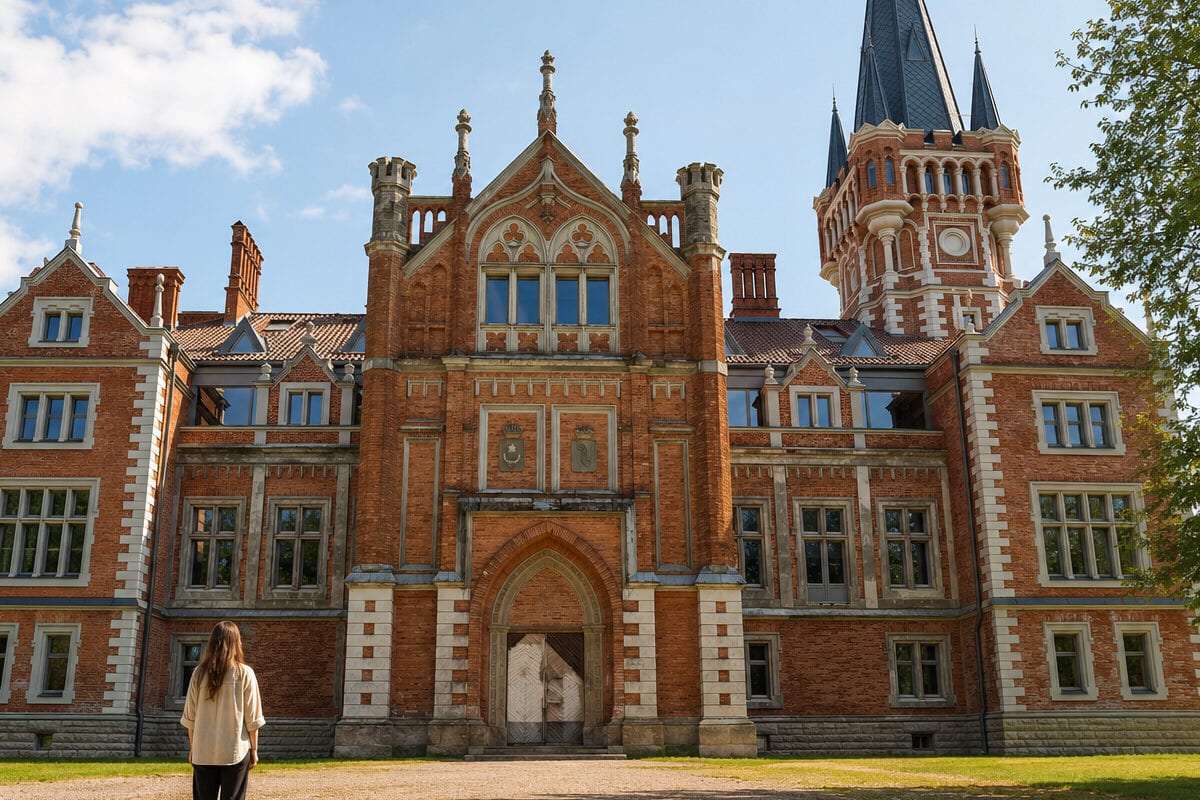
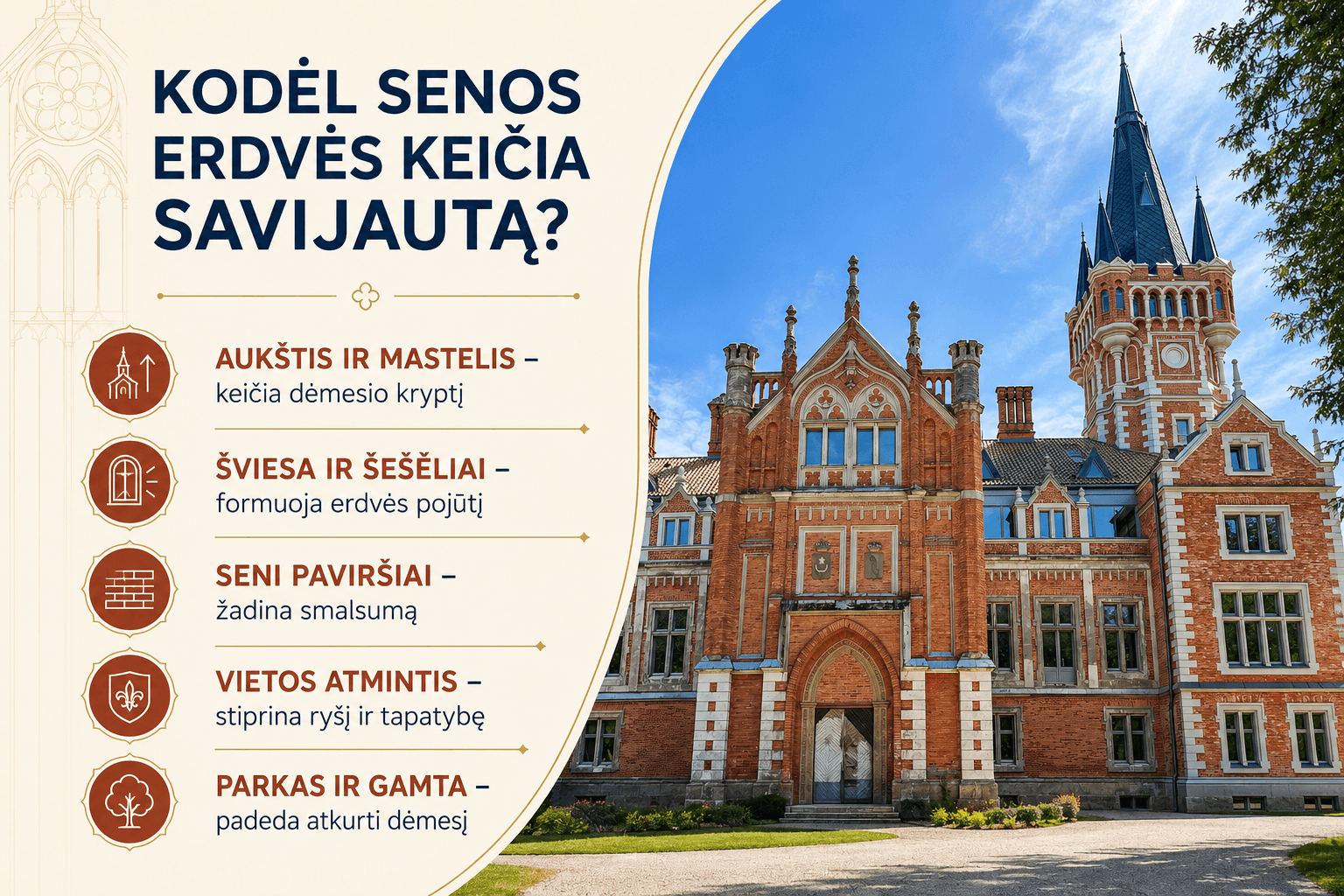
Standing in the courtyard of Lentvaris Manor, your gaze naturally drifts upward. The tower, the spires, the vertical lines of the facade, and the neo-Gothic ornamentation force you to shift your usual line of sight. In our everyday environments, we mostly look at screens, door handles, cars, and other objects scaled to human height. Standing before the palace, the body encounters a scale that vastly surpasses it.
This reaction begins even before any conscious evaluation of the architecture. The eyes search for focal points, the head tilts, and both posture and walking pace change. The brain simultaneously processes the symmetry of the facade, the height of the tower, the rhythm of the windows, the color contrasts, and the distance to the building. For a brief moment, the individual ceases to be the sole center of their own attention.
This is why people often fall silent or lower their voices in an old space of impressive scale. It is not necessarily out of respect for history. The body is primarily trying to understand the place: is it safe, where can one move, what is worth looking at, and what kind of behavior does it demand? Architecture transmits these signals without a single written word.
Height, light, and spatial openness affect our emotions
Studies in environmental psychology and neuroarchitecture show that a room's height, sense of enclosure, and shape can influence aesthetic judgment and the desire to linger. High ceilings are more often associated with spaciousness, the freedom to look around, and heightened visual curiosity. Conversely, low, windowless, and difficult-to-navigate spaces can make some people want to leave as quickly as possible.
This does not mean that a lofty hall automatically improves one's mood. Human reactions are shaped by a multitude of factors: lighting, temperature, acoustics, past experiences, and even whether the person is there by choice. Nevertheless, spatial proportions are not merely a decorative architectural decision. They alter the direction of a person's attention and the way they move.
At Lentvaris Manor, this effect is amplified by the shifting light. Outside, the eye is drawn to the red brick facade and light-colored trims, while inside, it must adjust to more subdued lighting, deeper niches, and shadows. Throughout the day, the light moves with the sun, meaning the same room is perceived differently in the morning, at noon, and in the evening. The experience of historic architecture is not a static image—it is constantly transformed by the time of day.
The materials of an old building allow us to feel time physically
Modern spaces are usually designed with uniform surfaces that are easy to clean and quick to replace. An old building operates differently. The color of the bricks is never perfectly uniform, the wood bears the marks of use, and stone surfaces have been altered by moisture, frost, and human touch. Every material ages at its own pace.
Such surfaces give the eye more work to do. The gaze does not rest on a seamless plane; instead, it begins to look for differences, repetitions, and explanations. Why is one part of the wall darker? Where was the previous opening? Which detail is authentic, and which was added during a later renovation? The building encourages exploration, even from someone who has never previously been interested in architectural history.
While restoring Lentvaris Manor, we constantly face the choice of how many signs of aging to leave visible. A surface that looks completely brand new might be tidy, but it also loses its connection to time. For this reason, the goal of restoration cannot be limited to a desire to smooth out and repaint everything. Enough historical authenticity must be preserved so that visitors understand they are standing in a building that has outlived several generations.
The memory of a place is forged by human stories and the traces they leave behind
A building does not remember on its own. Memory emerges when people connect a specific place with events, family stories, images, and personal experiences. To one person, Lentvaris Manor recalls the era of the Tyszkiewicz family; to another, it is the carpet factory; to a third, it is the abandoned palace they saw in their childhood. For today's visitors, it might already be associated with a guided tour, a lecture, or their first visit to the tower.
In environmental psychology, this connection is known as place attachment. It is formed by the architecture, the history of the area, and the individual's own life. Studies show that people living in historic districts often feel a stronger bond with their surroundings. Buildings become reference points by which periods of life are remembered and the identity of a place is understood.
In the case of Lentvaris Manor, this memory is not monolithic. The palace has had different owners and purposes; it has been a representative residence, an administrative building, and an abandoned site largely inaccessible to the public. In restoring the manor, we cannot simply cherry-pick the most convenient era of its history. All these layers explain why the building looks exactly the way it does today.
The manor park helps the mind shift into a different mode of attention
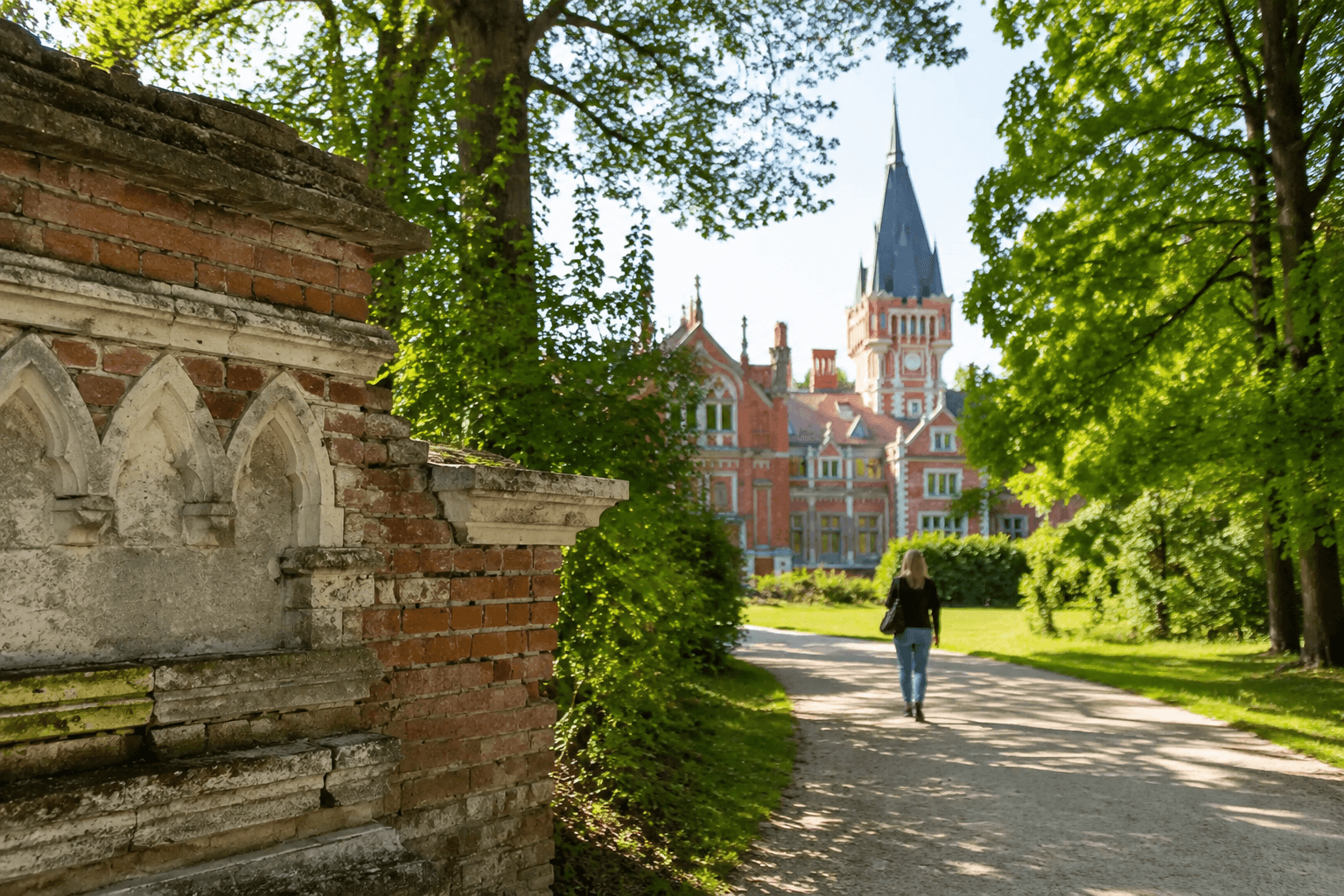
The impact of the palace cannot be separated from its surrounding environment. In the Lentvaris park designed by Édouard François André, architecture was integrated with the terrain, water, trees, paths, rock compositions, and ever-changing perspectives. A person was meant to move through it and discover the views gradually.
In our daily activities, we use directed attention: we read, reply to messages, drive, calculate, and solve problems. This kind of attention is exhausting. In nature, our gaze is drawn to moving leaves, the surface of the water, the shifting light, and distant perspectives. This does not require constant willpower, allowing the mind to briefly release its tension.
A historic park adds another layer to this effect—curiosity. The visitor observes nature while simultaneously trying to discern what within it was created by human hands. A path, a grotto, a pond, or a stone composition may look natural, yet their placement was carefully orchestrated. Because of this dual experience, a walk becomes slower and more mindful.
Old spaces can be calming, but dereliction sometimes causes anxiety
It is easy to romanticize old buildings. However, age alone does not create coziness. Dampness, poor lighting, unclear pathways, damaged structures, and a neglected environment can induce a feeling of insecurity. People appreciate more than just architectural beauty—they also look for signs that a place is being cared for.
This is why restoration also has a psychological impact. Reinforced structures, a clear route, proper lighting, and the return of people alter the perception of a building. A place that once seemed forgotten begins to signify continuity. Events, guided tours, and gatherings give the palace a contemporary social role.
Studies show a correlation between visiting historic sites, higher life satisfaction, and reduced psychological stress. However, one cannot conclude from such data that a visit to a manor cures mental health disorders. A historic environment can help us step away from our daily routines, stimulate curiosity, and provide a sense of belonging to a longer history. This is significant, but it is not a substitute for medical treatment.
The impact of Lentvaris Manor is created by the synergy of architecture, nature, and people
The impact of Lentvaris Manor cannot be explained solely by the height of its tower, its old bricks, or the history of the Tyszkiewicz family. It emerges from multiple layers: the scale of the building, the light, the acoustics, the materials, the park, the stories, and the people who are once again gathering in this place.
One visitor will first notice the architectural details, another will be drawn to the restoration process, and a third will find peace in the park. To someone, the palace might seem majestic; to another, it may feel heavy or even unwelcoming. There is no single mandatory reaction. The space intersects with a person's individual experience, making every visit slightly different.
Our task is to preserve the manor's authenticity while creating the conditions for people to experience it safely. A building remains alive when you can inhabit it, listen, observe, and forge new memories within its walls. That is precisely when historic architecture becomes a part of the present.
Sources and recommended reading
- Proceedings of the National Academy of Sciences. Impact of contour on aesthetic judgments and approach-avoidance decisions in architecture. https://doi.org/10.1073/pnas.1301227110
- Journal of Environmental Psychology. Architectural design and the brain: Effects of ceiling height and perceived enclosure on beauty judgments and approach-avoidance decisions. https://doi.org/10.1016/j.jenvp.2014.11.006
- Historic England. Wellbeing and Heritage Evidence. https://historicengland.org.uk/research/current/social-and-economic-research/wellbeing/wellbeing-and-heritage-evidence/